Keep informed of TAT events and receive our free monthly Forum filled with inspiring essays, poems and images. Sign Up Now
Receive new-Forum notifications each month and keep them coming:
The TAT Forum is a free, online spiritual magazine of essays, poetry, and humor. Please subscribe to receive a notice when new issues are published. You will receive an email notice at the beginning of each month when the new issue of the TAT Forum ezine is published. You may also a few mailings per year concerning special events.
Privacy and security: Your information will be kept strictly confidential and will never be shared with any third parties, including businesses, agencies, or other organizations.
Please remember to check your email program’s spam folder and add (webmaster at tatfoundation dot org) to your list of contacts to ensure the TAT Forum notices are not mistakenly labeled as spam or junk email.
If you’re not seeing your TAT Forum new-issue email notices in your in-box, check your spam folder and other folders that your email client may be putting mail into. Gmail, for instance, now automatically places emails from Facebook, Twitter, or LinkedIn into the Social tab, while most email marketing campaigns find their way into the Promotions category.
When you whitelist an email address in Gmail, this ensures the email shows up in your Primary Inbox rather than other tabs. You’ll also get a notification on your device or desktop when you receive an email in your Primary Inbox, unlike emails that go into the Promotions category.
Whitelist an email sender in Gmail 1) Login to Gmail, click on the gear icon and select “Settings” 2) Select “Filters and blocked addresses” 3) Scroll past all your existing filters and select “Create a new filter” 4) Add (webmaster at tatfoundation dot org) to the “From” field and check “never send to spam.”
Primary inbox vs. Social, Promotions, etc. 1) Login to Gmail, click on the gear icon and select “Settings” 2) Select “Inbox” 3) Adjust “Categories” 4) Click on “Save Changes”
=> [I don’t use Outlook or Yahoo mail, but here’s what I’ve read about whitelisting with them. Please let me know if any of these examples are incorrect or outdated—Ed.]
Whitelist an email sender in Outlook: To do this, choose Settings, then Options. In the left pane, choose Junk Email, then Safe Senders. In the box, enter the (webmaster at tatfoundation dot org) email sender or the (tatfoundation dot org) domain, and select the Add button. Click Save, and you’re all set.
Whitelist an email sender in Yahoo mail: 1) Navigate to “Settings” icon, then click “More Settings” from the Yahoo Mail menu. 2) Select “Filters” and hit “Add” to enter the (tatfoundation dot org) domain name or (webmaster at tatfoundation dot org) sender.
If the subscription process does not work, simply send an email to (forum at tatfoundation dot org).
(As an Amazon Associate, TAT earns from qualifying purchases made through links on our website … or save this link to use.)
Note for Forum readers regarding email links: If you click on an email (mailto:) link and it doesn’t automatically compose the start of an email response, a right-click may give you an option to indicate an email app and/or an option to copy the link address which you can paste into an email that you initiate.
TAT members share their personal convictions and/or concerns
Discerning a True Direction: Nostalgia as Our Inner GPS
Speaker Notes from a November 2015 TAT Foundation gathering:
“Let yourself be silently drawn by the strange pull of what you really want. It will not lead you astray.” ~ Rumi
Nostalgia is confused by many with sentimentality, but in its true sense it offers a valuable tool in finding our way to that mysterious place called “within.” How can the nostalgic mood help us to discern a true path from those dead end trails offered by the imagination? Is there truly a better “place,” a more real “reality,” one without conflict and dissatisfaction? Let’s explore the nostalgic mood together, and see.
For the interactive sessions, we’ll give personal examples of nostalgia, looking for clues as to how they help discern base feelings and moods from true longing. In preparation, participantsare encouraged to remember glimpses of nostalgia, to share them with their fellows:
Intro: Define nostalgia. What it is not. It is not sentimentality, but something deeper, it points to something real, not to a memory or sentimental mood. What you think nostalgia means and how it can be a tool of discrimination in the land of moods and the emotional center. And we can talk a bit about the inner country and moods, lead this into dreams and nostalgic mood for dreams.
The refinement of nostalgia. How at first it’s more like a desperate longing. Very distinct mood of trying to find help. As we go along it becomes more refined until it becomes more like our connection to the heart or the connection to the higher power. The thread back to our source.
Loss of the innocent mind: Story of how you see fell into the meanness and bullying in elementary school, how it was a first exciting, until you became the target. How you felt sad at the loss of your friend’s innocence, and afraid of how it so easily affected you. Story of the Einstein talk, and how soon puberty knocked this out too, and left you with no clear feeling of how to face life; it had become dog-eat-dog, with ever-changing rules, no inner point of knowing.
Basic definitions of nostalgia in Rose’s sense of the 3 dream moods: acquisition, fear, and nostalgia, how we can discriminate between these. Nostalgia is the helpful one. How Rose defined guilt: nostalgia and fear. The “act” was losing our innocence, and nostalgia can point back to it.
Describe nostalgia from the point of view of consciousness of a child, leading to conscience in the sleeping adult.
Our connection to it is what is called conscience. How Rose said you cannot hurt the child’s essence, but you can destroy its potential. This is what happens, we lose our given potential for this life, and get a fake role in whatever society we find ourselves in. We lose our Truth, and get a “life.”
Relate to the above examples.
Ask folks if they can remember when they lost their innocence, when the pure consciousness of childhood began to leave, and when was it replaced by the learned consciousness of an adult in society, and how this is a movement from innocence to error.
Practical method for becoming familiar with nostalgia: try finding the nostalgic mood through a meditation practice. I did this mainly while walking. Clear the mind with whatever technique you are familiar with, then focus on your emotions. What emotions are currently in charge, in your consciousness, as a cloud, a color. Find your longing, your link to something good, a better state. Allow this to displace whatever the negative emotions that might have been present, such as anger, resentment, envy, neediness. Gratitude, a feeling of humility: these might help to find a nostalgic link.
Important point is to do any meditation or looking into the emotional state as if it’s the first time, every time. The mind is prone to take anything we see, and transfer it into memory to be used as the equivalent to direct experience, thus taking us out of the game. Pure and honest, first time, every time.
Next, once you have “remembered” the nostalgic mood, inquire as to why the other moods were dominant. Where does your value system really lie? Can you see your way around the emotional landscape? How does your longing or nostalgia play out? Is there action involved? Or just dreaming?
Nostalgia as the way back to the pure consciousness: The pre-childhood consciousness held our potential, it could lead us to, and help us through, what our task or place in life could be. It was replaced by the fear, ambitions and herd mentality, the fall into sleep and error instead.
Nostalgia is the positive way to link back up with this child consciousness. We can remember what this feeling of pure innocence and spontaneity felt like through the nostalgic mood. Think back from now along your life to when you were a baby, with no sense of “self,” pure, innocent. Nostalgia is a longing for this directly connected state.
We have wandered increasingly away from our source of inner wisdom, the direct mind, and come to rely on others and society to tell us how to live. Nostalgia can be a form of emotional discernment to help point us back within to our own source, the inner self.
Ask folks to relate their memories of this, of having a pure consciousness, and can they feel it still? Can they remember being led away from it? Do they long for it now?
It’s all about “ladder work” – helping and being helped
Richard Rose, the founder of the TAT Foundation, spent his life searching for the Truth, finding it, and helping others to find their Way. Although not well known to the public, he touched the lives of thousands of spiritual seekers through his books and lectures and through personal contacts with local study groups that continue to work with his teachings today. He felt strongly that helping others generates help for ourselves as well in our climb up the ladder to the golden find beyond the mind.
Call To Action For TAT Forum Reader
With the intention of increasing awareness of TAT’s meetings, books, and the Forum among younger serious seekers, and to increase awareness of ways to approach the search for self-definition, the TAT Foundation is now on Instagram.
You can help! A volunteer is producing shareable text-quote and video content of Richard Rose and TAT-adjacent teachers. We need your suggestions for short, provocative 1-3 sentence quotes or 1 minute or less video clips of people like Richard Rose, Art Ticknor, Bob Fergeson, Tess Hughes, Bob Cergol, Shawn Nevins, Bob Harwood, Anima Pundeer, Norio Kushi, Paul Rezendes, Paul Constant, Mike Gegenheimer & other favorites.
Please send favorite inspiring/irritating quotes—from books you have by those authors, from the TAT Forum, or any other place—to TAT quotes. If you have favorite parts of longer videos (ex: from a talk at a past TAT meeting), please email a link to the video and a timestamp.
Thank you!
TAT Foundation Press’s latest publication
Beyond Mond, Beyond Death II, composed of selections from the second 10 years of TAT Forum monthly issues, is now available on Amazon in paperback, Kindle and audiobook format.
Please add your review to the Amazon listing. It makes a difference!
*
TAT Press publications also available as audiobooks:
January “TAT Talks” online event: Saturday, January 31, noon ET. April Gathering (Claymont Great Barn): Friday evening through Sunday noon, April 17-19, 2026 June Gathering (Claymont Mansion): Friday evening through Sunday 2 PM, June 12-14, 2026 ** July “TAT Talks” online event: Saturday noon ET, July 18, 2026. ** ** August Gathering (Claymont Mansion): Friday evening through Sunday 2 PM, August 21-23, 2026 ** October “TAT Talks” online event: TBD. November Gathering (Claymont Mansion): Friday evening through Sunday 2 PM, November 6-8, 2026 December “TAT Talks” online event: TBD.
Our in-person gatherings in 2026 will be held at the Claymont Retreat Center in Charles Town, WV.
Have you seen the TAT Foundation’s YouTube channel? Subscribe now for spiritual inspiration (and irritation)!
Volunteers have been updating the channel with hours of new content! They’ve also curated some great playlists of talks by Richard Rose, teacher talks from recent & not so recent TAT meetings, episodes of the Journals of Spiritual Discovery podcast, and other great TAT related videos from around the internet.
Featuring: Richard Rose, Bob Cergol, Shawn Nevins, Bob Fergeson, Mike Conners, Anima Pundeer, Norio Kushi, Paul Rezendes, Bob Harwood, Tess Hughes, Art Ticknor, Shawn Pethel, Tyler Matthew and other speakers.
This month’s video is a clip “Die Before You Die” from a Plant Cunning podcast To Thine Own Self Be True interviewing Tess:
Local Group News
Groups with recently updated information are listed below. The complete listing of local groups is on the Find a Local Group page.
New Online Self-Inquiry group: Women’s online self-inquiry group, alternate Wednesdays at 19.30 UTC. To participate, contact tesshghs@gmail.com.
Update for the Online Self-Inquiry Book Club: We’re still looking for suggestions that have sufficient appeal. You can contact us at: https://meet.google.com/eqp-zucx-oww (ask to join).
Update from the Pittsburgh, PA self-inquiry group: > Use the e-mail link below for invitations to all meetings and to receive internal email announcements. > In-person bi-weekly meetings: our home for all future meetings is the Library of The Friend’s Meeting House in Oakland, Pittsburgh: 4836 Ellsworth Avenue, PA 15213. Current events are listed on Meetup “Pittsburgh Self-inquiry Live” and http://www.pghsig.org. – Sun, July 12, 2PM: Dean hosts “Compassion versus Empathy” – Sun, July 26, 2PM: “What about me is Real? What do I Know for Sure?” > Online group confrontation and individual contributions every Wed, 8:00 pm EDT via Zoom; current online events are listed on Meetup “Pittsburgh Self-inquiry Group” and http://www.pghsig.org. – Wed, July 1: “Self-inquiry, AI and Questioning” – Wed, July 8: “Is Reality a Mirror? Mirrors as an Effective Analogy” – Wed, July 15: Guest TBD – Wed, July 22: Lenny S. hosts: “Should we Ask … some Really Good Questions?” – Wed, July 29: Mike Whitely host: “Poems of Richard Rose” > All Forum subscribers are welcome to join us. > Email to receive weekly topics with preparatory notes and Zoom invitations. Current events are listed on Meetup as Pittsburgh Self-inquiry Group (link above) and on Pittsburgh Self-Inquiry Live.
> We advocate self-inquiry, which is to question our beliefs and opinions of ourselves and those of others through honest and sincere feedback all in a friendly environment in order to recognize errors in our thinking and assumptions. Each participant gets an allotted time to voice their thoughts on the evening’s topic to which others can question or comment. > Our format and inspiration for self-inquiry are influenced by numerous teachers and books, none more so than the teachings of Richard Rose which can be researched here: Our format and inspiration for self-inquiry are influenced by numerous teachers and books, none more so than the teachings of Richard Rose which can be researched at TAT (Truth & Transmission) Foundation.
A password-protected section of the website is available for TAT members. (Note that there’s an occasional glitch that, when you try to link to the members-only area or a sections within it, you’ll get a page-not-found error. If you try the link a second time, it should work.) Contents include:
How you can help TAT and fellow seekers,
Audio recordings of selected sessions from 2008-and-on in-person meetings and virtual gatherings.
Resources and ideas for those planning a group spiritual retreat.
Photographs of TAT meeting facilities, the Richard Rose grave site, a rare 1979 photo, and aerial photos of the Rose farm,
Presenters’ talk notes from April TAT meetings in 2005–2007, and
TAT News Letters from 1996–2013 and Annual Retrospectives from 1973 thru 2011. The Retrospectives from 1973–1985 were written by Richard Rose and are replete with ideas on the workings of a spiritual group—rich historical content.
TAT policies, TAT business meeting notes, and other information.
New audio recordings added in May 2026:
April 2025 TAT Meeting (most of the meeting was recorded except for Bob Cergol’s session).
June 2025 TAT Meeting (partial recording).
July 2025 TAT Talk with Bob Cergol.
There were no recordings made for the August and November 2025 meetings.
All 14 issues of the TAT Journal are available in pdf format. Paperback issues of a “Forum for Awareness” were published on a quarterly basis from 1977 until 1980 and then on an annual basis until1986. The Journal’s editorial staff members, all of whom were volunteers, described the publication as a meeting place for…
Esoteric searchers, transcendentalists, mystics, scientists for the new frontiers…
People who are dedicated to the development of genuine friendship among all levels of spiritual and psychological research…
People who see the need to share ideas, but who cannot meet personally, and for those who will give support and find support while seeking a common goal…
Specialists who see the value of broadening their perspectives by association with specialists in related fields and for people who, regardless of specialty, find a value in the psychological encounters with their fellows that help them to better understand themselves and so find peace of mind and a better understanding of their friends.
As an Amazon Associate, TAT earns from qualifying purchases made through the above link or other links on our website. Click on the link and bookmark it in your browser for ease of use.
TAT has registered with the eBay Giving Works program. You can list an item there and select TAT to receive a portion of your sale. Or if you use the link and donate 100% of the proceeds to TAT, you won’t pay any seller fees when an item sells and eBay will transfer all the funds to TAT for you. Check out our Giving Works page on eBay. Click on the “For sellers” link on the left side of that page for details.
Downloadable/rental versions of the Mister Rose video and of April 2012 TAT sessions on Remembering Your True Desire:
“You don’t know anything until you know Everything….”
Mister Rose is an intimate look at a West Virginia native many people called a Zen Master because of the depth of his wisdom and the spiritual system he conveyed to his students. Profound and profane, Richard Rose was not the kind of man most people picture when they think of mystics or spiritual teachers. Yet, he was the truest of teachers, one who had “been there,” one who had the cataclysmic experience of spiritual enlightenment.
Filmed in the spring of 1991, the extraordinary documentary follows Mr. Rose from a radio interview, to a university lecture and back to his farm, as he talks about his experience, his philosophy and the details of his life.
Whether you find him charming or offensive, fatherly or fearsome, you will not forget him, and never again will you think about yourself, reality, or life after death in quite the same way.
2012 April TAT Meeting – Remembering Your True Desire
Includes all the speakers from the April 2012 TAT meeting: Art Ticknor, Bob Fergeson, Shawn Nevins and Heather Saunders.
1) Remembering Your True Desire … and Acting on It, by Art Ticknor Spiritual action is like diving for the Pearl beyond Price. What do you do when you don’t know what to do or how to do it? An informal discussion centered around the question: “What prevents effective spiritual action?”
2) Swimming in the Inner Ocean: Trips to the Beach, by Bob Fergeson A discussion of the varied ways we can use in order to hear the voice of our inner ocean, the heart of our true desires.
3) A Wider and Wilder Vision, by Shawn Nevins Notes on assumptions, beliefs, and perspectives that bind and free us.
4) Make Your Whole Life a Prayer, by Heather Saunders An intriguing look into a feeling-oriented approach to life.
TAT founder Richard Rose believed that working with others accelerates our retreat from untruth. He also felt that such efforts were most effective when applied with discernment, meaning working with others on the rungs of the ladder closest to our own. The TAT News section is for TAT members to communicate about work they’ve been doing with or for other members and friends. Please your “ladder work” news.
Humor {(h)yo͞omər}
“One thing you must be able to do in the midst of any experience is laugh. And experience should show you that it isn’t real, that it’s a movie. Life doesn’t take you seriously, so why take it seriously.” ~ Richard Rose, Carillon
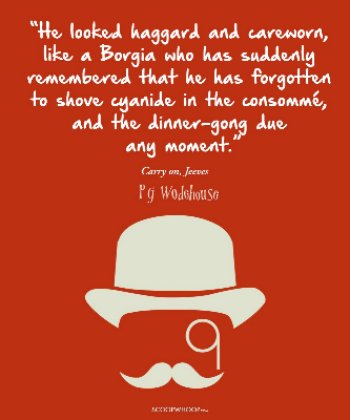
Like a Borgia?
*
~ Image from ScoopWhoop.com, featuring a quote from the novel Carry on, Jeeves by P.G. Wodehouse. These Wodehouse quote posters appear widely across the web.
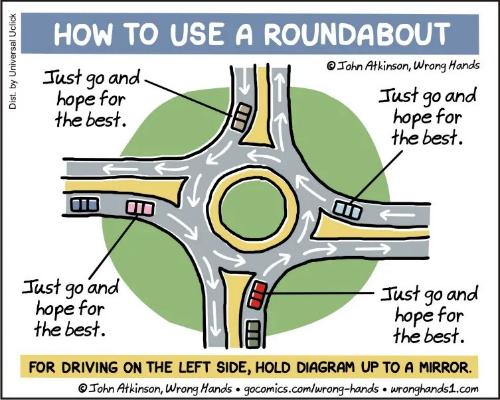
~ Thanks to John Atkinson, from his wronghands1.com website.
Inspiration & Irritation
Irritation moves us; inspiration provides a direction
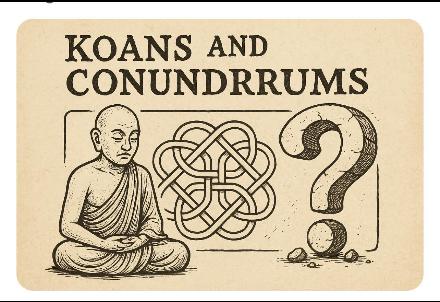
Koans and Conundrums
A while back I was listening to a TAT Talk by Shawn Nevins when a particular quote jumped out at me. I had listened to the talk several times as I worked on editing an audio program featuring TAT spiritual success stories. Shawn had been fielding questions from the Zoom talk participants and was searching for words to help explain how to wake up. There was a note of frustration as he responded to another “Yes, but how do we do it?” question. Shawn said:
“If we could just connect with our fundamental not knowing of who we are. The fundamental illusion that we live every second that we exist as an independent self, doing things and making decisions and being in this world. Being Shawn… and being all these names like these names are real and they’re not.
And the evidence presents itself to us continually over and over and over again as we struggle to try to keep illusory control over what’s happening.”
I found his response to be full of koans and conundrums. Let’s break it down.
Shawn says “If we could just connect with our fundamental not knowing of who we are.”
Ok. How do we connect with not knowing? A koan for sure. Do we do it by seeing what we are not? The Via Negativa? The path of self inquiry? Do we have to start by admitting that we don’t know who we are?
Shawn continues: “The fundamental illusion that we live every second that we exist as an independent self.”
That’s a tough one. The sense of self. Another koan. We feel like we are someone. But what if that’s not true?
He continues: “doing things and making decisions and being in this world.”
Another tough one. If we are not who we think we are (sense of self) then who is running around “being in this world”? “Being all these names like these names are real and they’re not.” A conundrum.
And finally the kicker: He’s trying to get us to see that we don’t know who we are and we are living an illusion of free will in an unreal world. But, not only is it not real, it is clearly not real!
Shawn says that “the evidence presents itself to us continually over and over and over again.”
Evidence? He says the evidence of illusory control of this life is plainly there to see. What is this evidence that Shawn sees that we don’t see? Is that why life feels like such a struggle? Because we’re just not getting it? Another conundrum.
But, while the koans and conundrums are challenging, even frustrating, Shawn is also giving us a reason to hope. The key is in his opening line, “If we could just connect with our fundamental not knowing of who we are.” That implies that it is possible to connect. There must be a way or why urge us to do it?
So, where does that leave us? We seek. We question. We look. We push against the “not knowing” and the “not knowing” pushes back.
~ Thanks to Michael Whitely, who also produced the image using ChatGPT. (Note the typical AI misspelling…)
Koan
Origin: The term is the Japanese pronunciation of the Chinese word gong’an, which literally translates to “public case” or legal precedent. Originally, they were historical records of dialogues between enlightened masters and their students. ~ Google AI Overview
The Goal: They are not “problems” to be solved logically, but rather tools meant to break a student’s attachment to conceptual thinking and guide them into a state of pure, intuitive awareness. ~ Ditto
Q: Do you have clarity on what you want most from your existence?
Q: Do you have a koan, an unanswered question, related to how to go about finding what you want most?
Q: Does it, or could it, guide you?
Knicks + Celibacy
The Knicks just won a historic basketball championship (the first one in 53 years) by defeating the San Antonio Spurs 94-90 in Game 5 on June 13, 2026. The team owner seemed to be encouraging the players to be celibate during the playoffs, and for the players to have frank conversations with their families about their commitment. ~ Brett S.
Google definition of sparkies:
Slang for Energy: It can occasionally be used to describe someone who is notably spunky, energetic, or clever.
Character Name: “Sparkie” or “Sparky” is a common, affectionate name for a lively dog or a cartoon character.
Sparky, a Public Domain Superhero Sidekick
Q: New York Post Sports labeled the owner’s suggestion as joking. Do you think he was?
The Truth Shall Set You Free … IF
Excerpts from the transcript:
Next to John 8:32, in an 1870s annotated the Gospel of John by a Jesuit scholar, in a margin note written in Latin:
Veritatum said queras veritas damas. In English “That you may know the truth.” But which truth? The truth Damasus deleted.
The Jesuit scholar who wrote the note in the 1870s was dead. The two later hands that had annotated the manuscript after him were dead. Pope Damasus I had been dead for 1620 years….
I had been given access through a professor whose name I will not put into this video because he is still alive and has not yet retired to a private theological library in a city in northern Italy. The library belonged to a religious order. Most of its holdings had never been digitized. The librarian was a man in his late 70s, a priest of the same order, who had worked there for 40 years, and could remember the shelf locations of manuscripts as if they were rooms in a house he had grown up in.
That afternoon in a cafe across the street from the library with a late October light turning the buildings the color of honey the old priest told me what the truth was and what Damasus had done with it and why for 1600 years no one had ever heard the verse the way the early Christians heard it. I have spent the 19 years since that afternoon trying to verify what he told me. I have read the Greek of John 8 in every critical edition I could find from Nestle Island to the older Wescott and Hort. I have read the Latin of Jerome’s Vulgate side by side with the old Latin translations that preceded it. I have read the surviving sermons of the church fathers of the second, third and fourth centuries on this passage. I have read the seven extant letters of Pope Damasus I. I have read the acts of the council of Rome convened by Damasus in the spring of 382 AD.
The old priest was right. Every word of what he told me I have been able to verify. The verse you read tonight in your Bible is not the verse Jesus spoke. And what was removed from your understanding of it is the most consequential single act of editorial censorship in the history of the Christian tradition. Let me show you what was taken. The Greek of John chapter 8:31 and 32 as the earliest manuscripts preserve it reads as follows:
Eodio to althian kai he alleia eltheros he. In English word by word Jesus said therefore to the Jews who had believed in him: “If you remain in my word, truly disciples of mine you are, and you shall know the truth, and the truth shall set you free.”
Three things in the Greek that the modern English translations do not let you see. Three small things, each of them so small that you could miss them in a casual reading and together so large that they change everything about what Jesus was promising. The first thing, the verse you know, the truth shall set you free does not stand alone. It is the second half of a conditional sentence.
There is a word in front of it that you have never heard quoted from a pulpit. The word is if. The full sentence is: if you remain in my word then you shall know the truth and the truth shall set you free. Jesus is not making a universal promise. He is making a contingent one. The truth is available only to those who remain in his word.
And the word he uses is menete from the Greek verb meno which means to abide, to dwell, to take up residence inside. It is not the verb you use when you are reading a book. It is not the verb you use when you are attending a weekly service. It is the verb you use when you are inhabiting a house, when you have made it the place where you live.
The second thing, the Greek word translated as truth is aletheia. And in the Greek of the first century, aletheia did not mean what modern English speakers mean by truth. It did not mean a list of correct doctrines you should believe. It did not mean a set of accurate factual statements you should affirm. It did not mean information at all. The word aletheia is built from two parts: the prefix a meaning not, and the noun leth meaning forgetting. In Greek mythology, the river Leth was the river the dead drank from in the underworld which made them forget their former lives. Aletheia is what is left when the forgetting is removed. It is reality that has been unhidden. It is what has been forgotten coming back into view. The truth Jesus is promising is not information. It is awakening. It is remembering.
The third thing the Greek word translated as free is eleutheria [freedom, liberty] from the verb ethereum, which means to liberate, to release from bondage, to set free in the sense of releasing a slave from his chains. And the bondage Jesus is talking about (in the verses that come immediately after) is not the bondage of Roman occupation. It is not the bondage of sin as the church would later define it. It is something much more specific and much more dangerous to the religious institutions of the day. It is the bondage of being told that your access to God depends on someone else.
Now, here is what almost no one will tell you. The crowd that Jesus is speaking to in this scene is not a crowd of outsiders. Look at the Greek again…. He is talking to his own followers, to people who had already accepted his teaching, to people who in the categories of modern Christianity would be considered saved. And what he is telling them is that belief is not enough. Belief is the beginning. The work after belief is to abide in his word until the forgetting is removed. Until reality stands unconcealed before you, and you are liberated from the long human habit of needing someone else to mediate the divine on your behalf.
The “remembering” that Jesus was cited as referring to may occur in a state of consciousness which Franklin Merrell-Wolff referred to as knowing by identity. We may recognize something we have no memory of seeing before and then realize it as our real identity. Merrell-Wolff audio recordings, e.g. “The Quest” (7 September 1972; 25 min) mp3 or download. [-Ed.]
Psychoactive Experimentation
“An interesting account of what taking mushrooms did to a guy who is known for talking about physical health…. I’m in general against the use of drugs for getting mystical experiences, but I also believe that at times they can have a positive effect. Like in this case: https://m.youtube.com/post/UgkxbFWRhqr3IeU8bBZ2RAuNTvqyB2StW8zO.
“… He says that he was pushed to let go of the self and let go of control, how letting go initially caused him terror, and how after letting go he explains that he was “home.” And how in that which he called “home” he felt wonder about existence and a desire for taking care of life on Earth….
<p”>His description of what the molecule showed him sounds quite similar to the experiences of many mystics. And I found it curious that a guy who is famous on the web for his materialistic goal of extending his body’s life and well-being had such an experience triggered by a drug. He mentions in another place that he tried mushrooms and that it was psilocybin.”
~ Sergio F. The image of Psilocybin mushrooms is from Wikimedia Commons.
Richard Rose felt that there was a spiritual window that opened for a decade in the 1960s with the widespread use of LSD and marijuana. The people who tried them may have experienced their “reality” melting into something that questioned their identity. But many of the users got “hooked” on them to escape reality or recreate intense experiences, often leading to anxiety, “bad trips,” psychosis, and flashbacks. He said that in his public talks in the early 1970s he would come across habitual users of perception-altering substances who would be crying when they listened to him talking about becoming the Truth … because they felt it would be impossible to gain the necessary mental clarity for self-inquiry. [-Ed.]
Q: Are you willing to share your thoughts, feelings, opinions, etc., about experimenting with psychoactive substances for self-inquiry? If so, see the Reader Commentary question for next month below.
Please your impressions of the above items.
Reader Commentary
Encouraging interactive readership among TAT members and friends
A reader wrote that what would make the Forum more interesting would be:
Hearing from people who are searching—and have questions instead of those providing endless advice and “answers.” What challenges they are facing. What their doubts and questions are. How they perceive their path is going. What they are doing in their lives. Where they think they will end up, etc., etc.
Can you help make the Forum more interesting?
The Reader Commentary question for the July TAT Forum came from Phil C:
What are the hallmarks of a good spiritual teacher?
Responses follow:
From Paul Constant:
The following hallmarks of a good spiritual teacher relate to someone who is grounded in direct realization of Truth and living sanely from that newfound perspective:
• Communicating with clarity, authenticity, honesty, and a good dose of humility.
• Teaching with reluctance but recognizing that many sincere spiritual seekers have a deep longing to know Truth and need help with their search.
• Asking insightful questions to challenge the seeker’s thoughts, beliefs, and convictions.
• Providing advice but allowing seekers to independently follow their own path; encouraging the testing of advice without advocating blind belief.
• Encouraging healthy skepticism about everything except the seeker’s own ability to become Truth.
• Discerning when to inspire and when to skillfully irritate the seeker.
• Having intuition and wisdom about human psychology and suffering.
• Having the seeker’s best interest at heart.
• Knowing when to provide encouragement and when to provide tough love.
• Teaching with a strong air of friendship and desire for rapport.
• Discouraging dependency on the teacher and encouraging friendships with others who are exploring spiritual paths.
• Listening intently to get a clearer understanding of the seeker’s perspective; knowing when to talk and when to remain silent.
• Willing to work with seekers at various levels of spiritual maturity and Being.
• Being transparent about his or her own life.
• Ensuring that seekers never cede their own authority.
Warning!
Lest the teacher do more harm than good, all seekers should use sharp discernment and remain wary of the following:
• Teachers who are dogmatic, narcissistic, controlling, or self-deluded.
• Emotional and physical abusers, bullies, charlatans, moneygrubbers, ego-flatterers, and sexual exploiters.
All of these behaviors and traits serve as the basis of a cult. Self-realization should never excuse a teacher for these behaviors, regardless of the seeker’s tendency to minimize their importance. Caveat emptor!
From Nicolas Gallucci:
1. Sincerity.
2. Being genuinely enlightened, as in: There is nothing but The Absolute (Self, Ground of Being, Tao, God, or some other name) and nothing else exists. If this be confusing to them, they are either being coy for your own sake or you need to move on.
3. Accessibility.
4. Interest and ability to address scrutiny from peers and those they choose to work with.
5. Capacity to provide relevant scrutiny.
6. Capacity to manage and question their self-centric motivations surrounding the promulgation of their teachings as well as in their daily life. (Necessary since self-centricity has been transcended, not eliminated.)
7. Ability to suspect/explore/figure out that Being Itself is a contingent “Being.” (It is rare to have arrived at the Unknown and even more rare to attempt/stomach the exploration required to proceed into the Unknowable, typically considered something attained when one quits the body.)
From Tim Howell:
A good teacher helps clear obstacles and provides an experienced guide on the path. If the teacher rings that inner Gong as Rose did for Art, all the better.
From Tess Hughes:
1. The teacher must know where the student is trying to get to, even though the student does not yet know where they are heading.
2. The teacher needs to see how or where the student is going off course, because not knowing the direction, the student goes off course.
3. Because we keep forgetting, at least in the earlier stages, the teacher needs to keep reminding the student of the direction and the real possibility of success for them.
From a reader in Mexico:
Passing over good and getting to the bad is this: “I’m enlightened and you’re not, but if you try real hard and get with the program maybe some day you can be like us and we’ll let you in the club.”
From Shawn Nevins:
I resonated with Bob Cergol’s comment regarding the questions from the May Forum: “Taken as a whole, the questions demonstrated a wide range of strongly held preconceptions and implied beliefs, or at least standardized and acceptable language regarding what an answer to searching must be and how it must be manifested in a finder.”
I found it apropos that the often lengthy answers to those May questions that appeared in the June Forum followed the outstanding Nisargadatta dialogue “Nothing Else Matters.” One could not be more simple or profound in distilling the search to its essence. Imagine if the June Forum would have had nothing but that one minute of dialogue. “Go within and discover what you are not. Nothing else matters.”
From Bill Racine:
The good spiritual teacher stands at the exact midpoint between humility and arrogance, between gentleness and harshness, and is the embodiment of Truth and trustworthiness. The good spiritual teacher does not proselytize but guides the acolyte to Self-awakening. He or she resides at the center of the Yin/Yang and knows The Absolute: “I am infinity and I am nothingness; all that is, existed before the beginning, and nothingness is the essence of everything that is; everything dies and nothing ever dies; I walk between beseeching God’s help and commanding the forces of manifestation; I am the fullness of ego, and I am the emptiness of egoless-ness; I am the I and I am the i, I am not this and I am not that, and I am both this and that; I bear witness to the infinity of knowledge and being, yet what I know is but a thimble-full of the boundless ocean. ”
From Art Ticknor:
A good spiritual teacher is an amateur helper, not a professional teacher.
“A teacher is a professional who helps students acquire knowledge, competencies, and values. They design and deliver instructional strategies across various subjects, fostering intellectual growth and personal development.” ~ Google (prompt: define teacher)
“Historically and fundamentally, a professional is someone who receives payment for an activity, in contrast to an amateur who does it for personal enjoyment.” ~ Ditto (prompt: define professional)
“The spiritual meaning relates to the non-material, intangible aspects of existence—such as the soul, consciousness, and deep inner awareness.” ~ Ditto (prompt: define spiritual)
Some suggestions:
1. Be cautious of anyone who says they know what will take you where you want to go. Don’t assume that anyone or any organization has a formula.
2. Work with seeker-peers and with anyone you intuit who has found something you’re looking for.
3. Consider the possibility that the ultimate spiritual goal is finding your true identity. Labels such as Self-Realization or Becoming the Truth imply an absolute state of being that encompasses what you are, always have been and always will be.
4. Richard Rose, my primary spiritual teacher, cautioned students not to believe what he said but to find the Truth for themselves. Google’s response to: spiritual teacher Richard Rose “don’t believe me” began with:
Spiritual teacher Richard Rose taught that you should never blindly accept his words or adopt a belief, famously urging students: “Don’t believe me.” He argued that belief requires no genuine investigation and only masks one’s ignorance. Instead of accepting dogma, he challenged seekers to verify spiritual truths for themselves through direct experience and diligent self-inquiry.
In the June Forum, finders responded to questions posed to them by seekers, and one of the finders, Mr. Cergol, chose my question out of the 66 as most important to self-inquiry: “What should I do?” For me this question represents Richard Rose’s suggestion to keep turning over every rock possible, to continually attempt the best possible in order to find a Final Truth. But also, it represents a hole that persists and despite all the books, teachings, techniques and meetings that I throw in, it has not been filled. Is the ambitiousness of the me who wants to fill it actually a yearning that knows that to enter it would be a door as a solution to seeking my Source? Is that hole the same void, the Dazzling Dark, the Dark Night, the Nothingness that mystics and finders talk about? So why is Mr. Cergol trying to get me to fill it? Perhaps my attempts are the only way in which I could not avoid it, the only way I might accidentally face into it, by taking it seriously enough to act upon it and continually so, until every act possible is proven futile. If my survival nature makes it impossible for me to willingly enter that void of uncertainty, then my only strategy may be to face it but still actively avoid it—unless some Thing has different plans for me.
From Gus R:
The article “Sittings of Strong Determination” by BH last month was, for me, a disturbing reminder of my not pursuing what I feel would be the best that I should be doing as a spiritual seeker. Someone said at a TAT weekend that we as seekers have read enough books, gone to enough meetings, heard enough teachers, and that it was time to go within. BH mentioned in his article that it was easy to meditate ten hours per day, to not talk, to not stay afloat on the internet when locked in a room with an administrator carrying a kyōsaku stick “reminder”.
My insight, which I am sure most do not share, is that it is the troubling bits of wisdom that I hear that seem to point at the truth for me. I don’t think a one-day or a one-week retreat-escape would benefit me at all. I would look forward to it with enjoyment! Gurdjieff once said that effort on the path is meaningless—it is only the extreme efforts from which one could benefit. For me this is troubling, and if this were so, then what am I avoiding? Where would I need to apply the extra effort in order to progress? That, I am convinced, is not during any escape I could arrange, no retreat, cave or joining a club of deprived would-be monks or nuns. Something much more severe for me would be a constant vigil, one in place of my near continuous sleep-state existence and one of extreme effort.
Within perennial wisdom is a statement always curious to me, something about something “outside the scriptures,” outside any prescription, direction or path that someone, anyone else, has traveled or even suggested. Mr. Rose as well as many mystics describe it as “entering the desert,” where there are no footprints, no path, no sign posts to follow. Is it possible that one could live one’s life as if in that desert, always alert, always watching, on a journey always leaving behind more and more to become less and less as if to reduce oneself, in preparation for an eventual most difficult passage, one demanding such incredible commitment and effort to just get there, and then to only not know. The guidance provided could necessarily only be from within, always an invisible but always increasingly more reliable. It would be a lifestyle like no other. It’s easy to live the lifestyle of a farmer if you live on a farm, or to live like a doctor, a priest, monk or salesman—the roles and accoutrements are laid out for you. Lifestyle is a way of life in an environment aligned to one’s commitments, but this seeker lifestyle is one of commitment directed within. True adventure is tempting the fate of an otherwise sleeper struck by the allurement of the Not Knowing characteristic of that eventual desert within. It is through what FMW referred to as “our door to the Eternal (that) has been neglected.” Through his “Induction” he hoped to lead some who were brave enough to enter.
I recall a short story about a green door that would suddenly and mystically appear only to disappear before the adventurer could return to further investigate. He missed the opportunity when it would present itself. It seems some opportunities are available only when the time is right, when one must jump at the opportunity, as if into a passageway which would lead elsewhere to that which one would never know once the opportunity had passed. The green door is just that for me: an opportunity yet a troubling bit of wisdom that I fear, yet still anticipate to be right before or behind me, always in reach. Yet, do I hesitate awaiting the time to be right, too?
=> The Reader Commentary question for next month, the August 2026 TAT Forum, comes from the “Psychoactive Experimentation” article above:
What are your thoughts, feelings, opinions, etc., about experimenting with psychoactive substances for self-inquiry?
Please your response by the 25th of July, and indicate your preferred identification (the default is your first name and the initial letter of your last name). “Anonymous” and pen names are fine, too.
PS: What question(s) would you like to ask other TAT Forum readers?
Q for all: What are your thoughts on this month’s reader commentary? Please your feedback.
Richard Rose described a spiritual path as living one’s life aimed at finding the meaning of that life. Did you find anything relevant to your life or search in this month’s TAT Forum?
We like hearing from you! Please email your comments, suggestions, inquiries, and submissions.
Sign up for notices of TAT’s four annual events, other virtual events, and free monthly Forums on our contact page.
Founder’s Wisdom
Richard Rose (1917-2005) established the TAT Foundation in 1973 to encourage people to work together on what he considered to be the “grand project” of spiritual work.
And the same thing goes for the power complex, or any of them. Any of them can kill us. But nevertheless, these egos, this survival ego, these vanities are put in us. Because if we weren’t vain we wouldn’t pursue. The male has to have this tremendous rooster complex: that he is in demand, that all he has to do is go out and make a few flourishes with his feathers and things will happen, and that this is his main purpose on earth. The computer somehow puts him in check, and then at some time or another it also turns him loose. Now – I say the umpire is not us, and it’s not even a good protector. And once your purpose is served, you’re expendable; somehow the computer or the umpire seems to have done its job, it disappears, and somebody else replaces you – with an equal amount of vanity that you had when you were playing the rooster.
And I think that all of this is in order. There’s nothing wrong with it; this is just nature defending itself; nature having blueprints – which all of the erudite sociologists and psychologists are going to change – they’re going to reprogram it. They’re going to reprogram us so that we will survive; we’ll get vaccinated against the detrimental qualities of perversion, dissipations, narcotism and alcoholism and God knows what.
So this is just basic survival. If you’re just interested in basic survival, then you get as far as the umpire. You may even form a religion, you may even call your actions sins, in order to help reinforce yourself against an early death. This is basically what religion is – it’s somatic, that type of religion. Now there are religions that go beyond that, but they have so little popular appeal that the meetings are held in caves and God knows where.
[break in tape]
Perceptions, projections, visions
There’s one other point in the basis of perception. As I said before, there’s more than one type: there’s sensory perception and mental perception And it’s necessary to understand this. Because we see a lot of stuff and we like to think “we” see it, but we don’t define who is “we”. We don’t define what’s going on when we’re seeing.
For instance, suppose you see a green apple – this is visual perception – and you throw the apple out the window. And then we can visualize the apple sitting right here on the table. We can still see that apple in our mind’s eye, sitting right here. We can even close our eyes; we don’t have to see it sitting there, we can see it in our minds. And we can see almost anything that way. Now of course they call this memory. But – supposing we have this apple in our mind’s eye and we decide that we’re going to have little red diamonds a half inch apart all the way around the outside perimeter. We visualize an apple with little red diamonds. Incidentally, there are a lot of cults – and I identify them as cults – that do nothing but visualize. I was listening to this tape the other day and somebody is saying, “See o-r-a-n-g-e. Now see blue.” And so on. And he’s taking people through this course, a hundred and fifty bucks for a weekend, for seeing different colors, being able to visualize them.
But regardless, you can. You can see an apple with swastikas on it if you wish. Now what is this? This is actually a mental picture. It is a mental picture that is seen that has never been real; there has never been an apple that grew on a tree that had diamonds or swastikas on it. So this is what I call visualization. This is the ability of the mind to create. And what it does, it projects someplace. As we say, we see it in our head, it’s projected there. A picture is seen. Anything that is seen is substantial. Whenever anything is recorded – like if five people see a mirage – then that mirage is substantial. That’s the same evidence that sends a man to the electric chair – five people, two people perhaps, can send him to the electric chair. If two people see a mirage, that’s legal evidence. It’s scientific evidence, it’s testimony, it exists. Erratic? – sure, it may be erratic; because when they move up to the scene where the mirage seems to be it’s not there.
But regardless, we have that ability to project, to create. And unless we understand our ability to project and create, we cannot start to look inside of our own head, because every step of the way we’re visualizing and projecting. How many people have been in the process of projecting what love is? – the color of the horse the man had to ride in on, what the horse looked like, what the guy looked like, the qualities that he had inside of him. Then projecting phony qualities of the person who is meeting the man on the horse. We’ve built up a whole phony system of the princess with no faults, nothing but every superlative, meeting the man on the horse, who has nothing but superlatives, and waiting for ten, fifteen, twenty years for this visualization to come true – angrily hating the world, because other people refuse to believe that dream.
So unless a person sees this early in life we go on. Sometimes we don’t know it; sometimes we think, “Oh, yes, I know what you’re talking about. I don’t get into that stuff.” No – you’re into something else, some other form of visualization. But this form of internal looking is a projection of this process-observer mind. It’s a mental projection. I’ll give you some examples of these different things now.
Examples20
Sensory perceptions: Objects are apprehended. Now when I say apprehended it means the things that you see or things you hear, touch, smell, etc., the five or six senses.
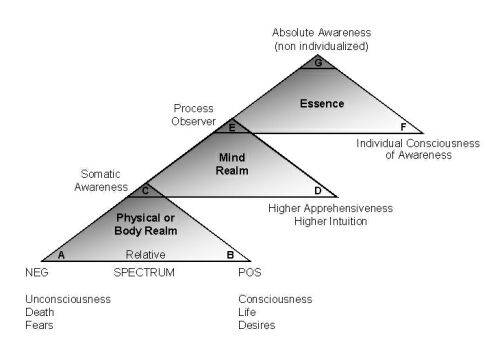
Memory perception: This is remembering and also visualization. But when you remember anything – for instance if I say to you that you would remember that log cabin you were born in, and it flashes back into your head: a farm back on a hillside with a certain slope, the logs sticking out of the corners of the log cabin, etc. – an exact picture, everything coming back to your head. Now this is a vision. This is not a projection. This is a perception. Whenever the memory is stimulated it produces a vision – even if it’s only a split second, if you’re running through things very rapidly …
… and you can see that, you can recall that. Call it back and it will appear.
Reaction visions: There are visions that we can only describe as being reactions; we don’t know their nature, we just react and we see them. We react to a certain situation, place, time, etc. – these are ghosts, visitations, mind projections. Sometimes these are things that we project out of the mind and seemingly see with the physical eye. But we project them first.
Holograms: A hologram is a reaction but we just don’t react properly with a hologram.
Hallucinations: Again, we don’t react properly; we see something that’s not there because it twists somewhere inside our seeing mechanism. In other words, our sensory-perception mechanism is not infallible. And this is another reason why we should question our own judgment in a lot of things.
Mental perceptions: This is a person perceiving with their awareness; true revelations about an unknown environment acting upon the mind, or the mind acting upon the mind.
Then we have deliberate projections. Is it possible to deliberately project? This is the fifth quality of the mind. We have ESP – that seemingly people do sit down and project. Also astral projection; and there’s another thing called zapping – this has been pretty well substantiated as being a power of the mind.
Okay, I don’t know whether I got the point across. If not, I hope that some of your questions will bring this across to you.
Man’s purpose
Q: In what you’re describing about nature, what is the purpose of getting this knowledge? To prepare you for the transcendental? [rest is inaudible]
R: I wouldn’t say that. I’d just say you start to see your purpose. And I don’t think that needs to be the only purpose, and I’m not inferring it’s a negative pursuit. I’m just saying that once you get wise to it, you may not have to suffer, you may not have to drown as quickly. In other words, you’re going to die. We’re talking about death. You’re dying right now; everyone here is dying, we’re approaching a certain end. Now – you can jump out the window or you can do it slowly. Consequently, when you realize what you’re programmed for, then naturally the unspoken thing is – what can you do to prolong it, while you’re taking time to learn? You don’t know, and a person has to prepare themselves in order to find out. What I’m trying to avoid for you is this idea of blasting yourself into knowledge. And instead trying to take a methodical, possibly laborious course of finding your definition, as opposed to extreme measures. It’s never been done with extreme measures.
And the other inclination we have, and I can’t argue with it, because every one of us has it: everyone moves as they’re supposed to move. Each person has a certain capacity, and no rationalization will identify their capacity, and you don’t argue with it. I hear people saying, “What good is that? – let’s eat, drink and be merry, because everybody’s kidding themselves who thinks there’s another objective in life.” And the proper thing to do, outside of saying, “Well, what is happiness?” or, “Who is being happy?” is to let the person eat, drink and be merry. Because if he doesn’t have the intuition or instinct or whatever is necessary, or hasn’t inherited the proper computer to do the work, he’s not going to go anyhow. He’s going to do what he was destined or programmed for. But the whole idea is trying to get a breath of relief from the programming, the treadmill.
Zapping
Q: What is the zapping you referred to?
R: Well, zapping is an instantaneous hypnosis. Zapping is a technique that came out of India. Gurdjieff 21 could zap. The first instance I ran into with zapping – there were certain yogis who came into this country forty of fifty years ago. One of them was Meher Baba,22,23 and he could look at you and you would collapse; he would just stare at you. Gurdjieff could look at you and you’d collapse. Because he established a mind-to-mind contact and then he pulled the strength out of you. There has been enough of this that has happened, and it’s predictable. They can predict they can do it and it can be done. And you can do it if you’re somewhat astute in hypnosis; you can knock people off their feet.
LSD trip
Q: [mostly inaudible – John Lily’s immersion tank ]
R: [inaudible – cracks some jokes] I’ve never been in one. I don’t know what it would do for you. It might be worth trying. I just don’t like the machinery there. It might be good. I’ll tell you something else, though: I don’t believe that you can take just anybody and put them there. It’s like LSD. I remember talking back four or five or six years ago with some people who had LSD and psilocybin and some other drugs. And I said, “What does this do for you?” One girl was talking about it, and she was pretty much of an authority on it – she had ruined both her kidneys with it. I don’t know whether the LSD did it or the needles or what, but her kidneys were shot, and she was pretty much of a philosopher in her last days.
But she said to me, “You get out of LSD what you put into it.” And I find that this is very true. Certain people take the same LSD – and one has nightmares, pursued by monsters and bad trips or something, while another person will take the identical LSD and have almost a spiritual experience. And I think the same thing goes for any of these experiments. You can’t get blood out of a turnip. If a person has certain basic innate qualities and they go into spiritual research, they either have to change their state of being – this is one of the secrets of it – before they go
… [whether that’s] for two lifetimes or ten lifetimes. He has to put something out there. I took LSD once – I was trying to see whether it would break open an experiential field that I had been in before. And I had a beautiful, a very beautiful experience. I died, incidentally. It started off by dying – I went through a death experience, and then I had a very beautiful experience.25 And I compare this with hundreds of young people that I talk to, and they couldn’t understand: an old bastard like me should have had a rough trip. I had a nice trip. But I think it was because of the way I approached it. I had prepared myself for it too.26 You can prepare yourself for these things.
I’m not trying to change a trend today, I’m only trying to sort some people out who may pick up an intuition from what I’m saying, that you can’t indulge in these many voices that the umpire would reject and come up with any good results. There has to be a certain change of being before you go into a search for spiritual experience. In other words, there’s a trend to have experience; there are a lot of people who want experience. And I’ve run into quite a few of them; they’d come down to my place and want to stay there, and I’d find out that they were into – I mean a whole lot of vices – and they thought that they could continue these things, all of these let’s say open spigots on the computer. The computer has to be shut. You have to put the material in the computer and then you shut off the input and the output, if you want a decision out of the computer. You can’t have a bunch of monkeys in there all the time jumping around.
You’ll have an experience and what will your experience be? Monkeys. That’s all.
[ break in tape ]
Words
Q: [Mostly inaudible question on meaning.]
R: Here’s the whole thing about words: words have whatever meaning you give them. That’s why I talk about the language of agreement. The unfortunate thing is that we don’t always agree on words or understand what another person means. For instance we use this word exceptional – you think that an exceptional person is a genius, but you pick up a dictionary and no, it’s a resident in a nuthouse. Another example is the words objective and subjective: as soon as a
_____
24 Timothy Leary, Ken Kesey. 25 Rose details his LSD experience in a letter to Robert Martin, February 18, 1969. See pages 104-105 of Peace to the Wanderer, pdf in this directory: http://selfdefinition.org/rose/ 26 By being celibate.
subjective matter is under scrutiny it becomes objective. This may be along the lines you’re talking about, semantics or meaning, and the meaning is very vague. The words don’t mean a whole lot, no matter who it is who’s talking. Sometimes the most you can do, as I said, is pick up something by intuition. That’s the key. Because words will confuse you.
Q: What was it you meant by “somatic”?
R: Somatic means the body
Q: You were talking about somatic religion.
R: I believe that a lot of our religion is somatic, and a lot of this is rejected. That we can only think in terms of ecstasy or hell. Especially the Christian religions. The tremendous love relationship between a sadistic God and a whole herd of masochistic people, who just love to go to hell.
Umpire and egos
Q: Once you realize that the umpire is programming, do you gain control over that and maybe stop its vices, or do you just watch its vices go on forever?
R: We know in almost all cases where we undertake therapy, that the change occurs with the recognition of the error. There’s no sense in trying to change the mechanism. Like with this idea of the survival urge: the survival urge is contributory to death but it also contributes to long life. If you try to mess with it you may get into prostate cancer.27 But you recognize what’s going on: where previously you thought that you were reproducing, that you were the rooster of the world, now you see that all of it doesn’t matter; it’s going to happen whether you’re there or not.
And it isn’t a question of denouncing, or labeling stuff as evil, or something of that sort – that’s nonsense. I don’t intend to imply that. I’m just saying that you become detached. And most people when they get older – I’m not saying all; I’ve seen people ninety years of age who couldn’t see, they were blind, they were still trying to feel, and they never got detached – but most people after awhile look upon all of this scheme as nonsense. But by then it’s too late.
What I’m trying to do is to age some young people. And that’s basically why they get their detachment, if it’s done.
I was doing a little bit of reading or digging, trying to find out where this thing of guilt came from. And I noticed the predominance of guilt in the Christian religion. Then I started looking through the religions of India and Asia and Zen and all this sort of thing. And where is the guilt in Zen? You don’t find it. You find that they pretty much ignore it. But there’s a thread that runs through all the Hindu religions, and it’s generally spoken in let’s say little aphorisms. I ran into this when I first started studying yoga, years ago; I was a kid about twenty-three years old. And there was this little aphorism – I can’t remember exactly, but it says basically that all pain is caused by
_____
27 Rose advocated celibacy for young people but believed that extended periods of celibacy for older men could cause prostate trouble.
desire. Now where the Christian religion builds up a tremendous monster, “Oh, don’t you do this, because you’ll get so many years in the hot seat,” the eastern religions recognize the fact that man burns himself. Like St. Paul said, “If you don’t marry, you’ll burn.” 28 That man can burn himself by his desires. Now – this means that for anything you desire there are voices. These are egos. And any ego if you don’t develop some sort of detachment from it can burn you. It can cause you pain, ultimately. It can obsess you. It can develop a monkey.
Q: When you start the spiritual search you discover your selfishness and your egos and your desires. And then you move through that, you keep going and you lose your original reasons for searching. So then what keeps you going?
R: I’ll tell you what happened to me. Different people have different motivations. My original motivation for getting on a spiritual search was selfish. Looking at it from this viewpoint, I consider it very selfish. I had the conceit, number one, that I could master psychology, magic, kabala, astrology, all of these – which I look upon now as very weird pastimes – I would master all these things and become somewhat of a threat to humanity. But I didn’t go very far until it dawned on me that while all this power was being built up, I wasn’t achieving the big thing I would really want. And that was what? – that nowhere was I incorporating or getting in the general package enough knowledge to prolong my life, beyond the ordinary span of any other animal that was programmed to live so long.
And I came to the conclusion – and I don’t expect to and don’t particularly care to live any longer than my lifespan – but I realized then that what I wanted was to know the score. The motivation changed, and the ego-prompted thing wasn’t so important. But I maintain that you’ve got to hang in with your egos. This thing of abolishing egos or dropping egos is foolishness. This is the reason people get into too much dope or too much booze. They write it off in a sort of suicidal thing: “Oh, well I’ll go out that way, I’ll return to nirvana.” I heard a person make a remark one time – they found some people dead on a doorstep up in New York who had overdosed – and somebody said, “Oh, what a beautiful way to go.” How do they know? How do they know they went to nirvana, that they dropped all their egos? They may have entered oblivion, because of the range of their experience.
But regardless, it’s necessary to hang onto the survival ego, until you’ve got something better to replace it with. When you reach your final experience you’ll drop it – you have to die, you have to go through the death experience to achieve it – but you return. And you return once more hanging onto your survival ego, or you can’t function. So these are all implants, necessary to keep you moving. They’re not evil. They’re not evil in themselves. The only thing is to learn how to play the violin, to learn which finger to play, which ego to play. I call it “milk from thorns” – use this interior negative energy to develop curiosity – the right curiosity, not for the porno movies.
But you do change. You create what I call a vector – it’s an engineering term but it describes best what happens – that after awhile you’ll realize that you’re not an individual, you’re not a unique rooster that the world will never forget. And when that happens, the rooster that caused all this seems to be left behind. But what happened in the meantime was that you developed a vector – a curiosity, a dynamic hunger, a drive – and that stays with you. And that is basically who you are when the thing is over. You are not the rooster, you are not the person named Jack or Jill, you are a vector. You are basically a vector. You are what you do. Every man is what he does.
_____
28 1 Corinthians 7:9. “But if they cannot contain let them marry, for it is better to marry than to burn.”
Did you enjoy the Forum? Then buy the book! Readers’ favorite selections from seven years of issues. Beyond Mind, Beyond Death is available at Amazon.com.
Our free monthly newsletter with essays, poems, and reader commentary· Sign up today and get an excerpt from one of our newest publications: Hope! Life's Calling.














 Update for the Online Self-Inquiry Book Club:
 Esoteric searchers, transcendentalists, mystics, scientists for the new frontiers…