Convictions & Concerns: Arc of Life Epilogue, by Bob Cergol.
TAT Foundation News: Including the calendar of 2026 TAT events and a listing of local & online group meetings organized by TAT members.
Humor
Inspiration & Irritation
Reader Commentary: What question or questions would you like to ask people who say they are enlightened / know what they are / are Self-Realized / have no more questions / are Complete, etc.?
Keep informed of TAT events and receive our free monthly Forum filled with inspiring essays, poems and images. Sign Up Now
Receive new-Forum notifications each month and keep them coming:
The TAT Forum is a free, online spiritual magazine of essays, poetry, and humor. Please subscribe to receive a notice when new issues are published. You will receive an email notice at the beginning of each month when the new issue of the TAT Forum ezine is published. You may also a few mailings per year concerning special events.
Privacy and security: Your information will be kept strictly confidential and will never be shared with any third parties, including businesses, agencies, or other organizations.
Please remember to check your email program’s spam folder and add (webmaster at tatfoundation dot org) to your list of contacts to ensure the TAT Forum notices are not mistakenly labeled as spam or junk email.
If you’re not seeing your TAT Forum new-issue email notices in your in-box, check your spam folder and other folders that your email client may be putting mail into. Gmail, for instance, now automatically places emails from Facebook, Twitter, or LinkedIn into the Social tab, while most email marketing campaigns find their way into the Promotions category.
When you whitelist an email address in Gmail, this ensures the email shows up in your Primary Inbox rather than other tabs. You’ll also get a notification on your device or desktop when you receive an email in your Primary Inbox, unlike emails that go into the Promotions category.
Whitelist an email sender in Gmail 1) Login to Gmail, click on the gear icon and select “Settings” 2) Select “Filters and blocked addresses” 3) Scroll past all your existing filters and select “Create a new filter” 4) Add (webmaster at tatfoundation dot org) to the “From” field and check “never send to spam.”
Primary inbox vs. Social, Promotions, etc. 1) Login to Gmail, click on the gear icon and select “Settings” 2) Select “Inbox” 3) Adjust “Categories” 4) Click on “Save Changes”
=> [I don’t use Outlook or Yahoo mail, but here’s what I’ve read about whitelisting with them. Please let me know if any of these examples are incorrect or outdated—Ed.]
Whitelist an email sender in Outlook: To do this, choose Settings, then Options. In the left pane, choose Junk Email, then Safe Senders. In the box, enter the (webmaster at tatfoundation dot org) email sender or the (tatfoundation dot org) domain, and select the Add button. Click Save, and you’re all set.
Whitelist an email sender in Yahoo mail: 1) Navigate to “Settings” icon, then click “More Settings” from the Yahoo Mail menu. 2) Select “Filters” and hit “Add” to enter the (tatfoundation dot org) domain name or (webmaster at tatfoundation dot org) sender.
If the subscription process does not work, simply send an email to (forum at tatfoundation dot org).
(As an Amazon Associate, TAT earns from qualifying purchases made through links on our website … or save this link to use.)
Note for Forum readers regarding email links: If you click on an email (mailto:) link and it doesn’t automatically compose the start of an email response, a right-click may give you an option to indicate an email app and/or an option to copy the link address which you can paste into an email that you initiate.
TAT members share their personal convictions and/or concerns
How You Became the Reflection You See in the Mirror … And Get Lost in the Unfolding Story of Your Life
Epilogue following a presentation at the April 2026 TAT meeting:
I’m just not confident that many, or most in the audience during my presentation at the April 2026 TAT meeting understood what I was trying to convey. That’s probably on me. This bit of writing is an attempt to verbalize the same content more directly and succinctly.
The topic I was asked to speak on was the same as from a presentation I’d made exactly ten years prior, The Arc of Life.
In that previous talk I wanted to convey how you get lost in this unfolding story-of-your-life. I tried to do this by showing the structure of the story in a large wall chart, as ten stages comprising your life. For each stage I described two impersonal aspects: characteristics and theme, and two personal aspects: experience and agenda. At the close of that talk, I touched on overriding themes apparent in the entire arc of life, the entire story of any and every person’s life. That talk became the basis for my recently published book, HOPE! Life’s Calling, and an entire section of the book is devoted to it.
In my recent talk my goal was to convey more simply and essentially how one comes to be oneself in the world and simultaneously forgets one’s true, or original Self. The “you” that you have become in the world is a reflection seen, or projected if you like, in the fire-hose of experiences. Experience can be thought of as a mirror. You only know the world through your senses, and you come to see your existence in that world as reflected to you in the mind.
Growing up Catholic, I was taught that I was made in the image and likeness of God and that God was the maker of all things, seen and unseen. To my childhood mind and into adolescence I could only understand that idea as God somehow looking like me, though I also understood it couldn’t mean the physical image I witnessed in the mirror, but rather had to be something inside of me that was not easily seen. I imagined that unseen something overlapped or intersected somehow with my sense of being alive as me and knowing that I was alive as me, never mind that I did not really know what “me” was beyond a physical body. I was taught that I possessed a soul and that my soul was my link to God. Maybe that was the “likeness and image” I shared with God.
Fast forward several decades from childhood, after embarking on a spiritual path of attempting to define self through direct self-inquiry and then abandoning that path after a couple decades due to feeling as if life was passing me by while I was not profiting in the least from said spiritual path. After plunging into life at the deep end with both feet that didn’t touch the bottom, I found myself reverting to old habits of introspection amidst my otherwise entirely worldly-focused life consisting of marriage, children and scratching out a living as a self-employed software developer. That story is told in detail in my book, but suffice it to say here that it resulted in a realization that answered my deepest questions regarding who, and what I was, and how I was indeed made in the image and likeness of God. It gave me a perspective and understanding of how we become self-conscious individuals that are compelled to define themselves in the endless kaleidoscope of sensory existence.
You probably have heard that you are a sentient being. The phrase “sentient being” is not unique or specific to Buddhist teachings. Are you sentient? Do you possess sentience? What is sentience? Are all living creatures sentient?
Sentience equals the capacity to experience. It is not dependent upon personal self-consciousness or identity. It is a capacity you are endowed with prior to birth. It is not your possession. It comes from your God-nature – the ground of being. That capacity suggests awareness with experience being an object within awareness. A sentient being is endowed with the capacity to witness experience.
Experience equals observation of facts or events. What comprises experience? Is it merely sensors conveying to memory some reaction to stimuli? The camera on my phone can do that, but neither my phone nor the camera is a sentient being! Then what is a sentient being? The answer requires a deeper look into sentience, the nature of that capacity to experience, and the fact that there are two levels of experience: inner versus outer experience, i.e. two points of reference.
If the five physical senses are the sensors of external experience, then what are the sensors of internal experience? What is that sixth sense? It is the mind. Experience is occurring within the mind.
So, you are watching experience happen to you as conveyed to you through the five physical senses. But you are simultaneously also watching a stream of experience that has nothing to do with those physical senses. Internal experience stems from your reactions to external physical experiences. Anger is an internal experience. There is nothing in the physical world that stimulates any of the five senses to register anger in the body. It is your internal reaction to certain physical experiences that registers in the mind as anger.
Now we must bring in the notion of consciousness, because that something, that sentience that can experience, is conscious of both levels of experience. When exactly did you show up?! Weren’t experiences occurring long before that happened? Indeed, were those experiences that occurred within the stages of life between birth and the time that you showed up verifiably as you not what led to you appearing? When did you appear as a witnessable object in consciousness? Why can’t you remember being born? Why can’t you remember years of your life after being born.
Awareness is the unborn, undying, ground of being for all things, seen and unseen. I can’t prove this to you, but I know it beyond any doubt. I am that.
Embodied awareness equals sentience. Experience gives rise to the subject of that experience, i.e., a personal observer – he/she to whom that experience is happening. That observer of experience is in turn an experience happening within awareness, i.e., there is an anterior observer and witness to the experience of you!
So, now we’ve come full circle in my formulation above and this leads us right back to the arc of your life, beginning with the prenatal and birth stages. You begin life as a sentient being but without self-consciousness, without an identity, and this is why you cannot remember birth and the first several years of life. It takes a few years for memories to coalesce around a point of reference, and this point eventually becomes self-conscious ego. This is also why you are compelled to define yourself and why you cannot help but do so by looking at experience, both external and internal. Experience is a mirror.
You became the reflection you see in the mirror, both the one on the wall and the one in which you live, through misplaced focus of attention, inadvertence, and serendipity. You have gone through the looking glass and are lost in fantasy. The fantasy affirms ego identity and denies God-nature. Your essence is the impersonal, unborn, undying ground of being from whence you appeared. The personal, self-conscious you can only exist inside the fantasy it concocted in reaction to external experience to prove it is alive independent of God, Awareness, The Absolute, etc.
To find the world you must forget yourself. To find yourself you must forget the world.
There is a special irony in this because the very reason it’s true is because of the innate need to find oneself. In the process of trying to find yourself, you lose sight of your true Self. And the process of seeing that true Self involves a loss of your worldly self.
If you want to understand the process and the details by which this happened, you can do so by observing, in hindsight, the arc of your own life. In the process of such observing, you are traversing in reverse the arc of your life and, most importantly, the arc by which you forgot your God-nature and became lost in self-consciousness.
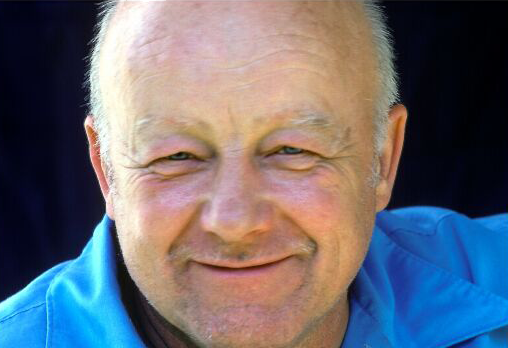
~ Thanks to Bob Cergol. The image is AI generated by magnific.com from prompt: “how you get lost in this unfolding story-of-your-life”. Please email reader commentary to the TAT Forum.
TAT Foundation News
It’s all about “ladder work” – helping and being helped
Richard Rose, the founder of the TAT Foundation, spent his life searching for the Truth, finding it, and helping others to find their Way. Although not well known to the public, he touched the lives of thousands of spiritual seekers through his books and lectures and through personal contacts with local study groups that continue to work with his teachings today. He felt strongly that helping others generates help for ourselves as well in our climb up the ladder to the golden find beyond the mind.
Call To Action For TAT Forum Reader
With the intention of increasing awareness of TAT’s meetings, books, and the Forum among younger serious seekers, and to increase awareness of ways to approach the search for self-definition, the TAT Foundation is now on Instagram.
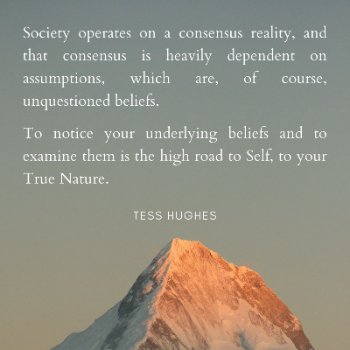
You can help! A volunteer is producing shareable text-quote and video content of Richard Rose and TAT-adjacent teachers. We need your suggestions for short, provocative 1-3 sentence quotes or 1 minute or less video clips of people like Richard Rose, Art Ticknor, Bob Fergeson, Tess Hughes, Bob Cergol, Shawn Nevins, Bob Harwood, Anima Pundeer, Norio Kushi, Paul Rezendes, Paul Constant, Mike Gegenheimer & other favorites.
Please send favorite inspiring/irritating quotes—from books you have by those authors, from the TAT Forum, or any other place—to TAT quotes. If you have favorite parts of longer videos (ex: from a talk at a past TAT meeting), please email a link to the video and a timestamp.
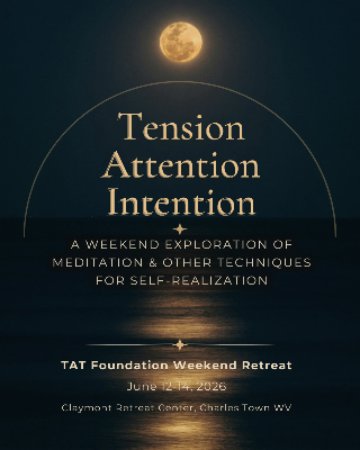
January “TAT Talks” online event: Saturday, January 31, noon ET. April Gathering (Claymont Great Barn): Friday evening through Sunday noon, April 17-19, 2026 ** June Gathering (Claymont Mansion): Friday evening through Sunday noon, June 12-14, 2026 ** July “TAT Talks” online event: TBD. August Gathering (Claymont Mansion): Friday evening through Sunday noon, August 21-22, 2026 October “TAT Talks” online event: TBD. November Gathering (Claymont Mansion): Friday evening through Sunday noon, November 6-8, 2026 December “TAT Talks” online event: TBD.
Our in-person gatherings in 2026 will be held at the Claymont Retreat Center in Charles Town, WV.
Have you seen the TAT Foundation’s YouTube channel? Subscribe now for spiritual inspiration (and irritation)!
Volunteers have been updating the channel with hours of new content! They’ve also curated some great playlists of talks by Richard Rose, teacher talks from recent & not so recent TAT meetings, episodes of the Journals of Spiritual Discovery podcast, and other great TAT related videos from around the internet.
Featuring: Richard Rose, Bob Cergol, Shawn Nevins, Bob Fergeson, Mike Conners, Anima Pundeer, Norio Kushi, Paul Rezendes, Bob Harwood, Tess Hughes, Art Ticknor, Shawn Pethel, Tyler Matthew and other speakers.
This month’s video features a short statement by Shawn Pethel:
Local Group News
Groups with recently updated information are listed below. The complete listing of local groups is on the Find a Local Group page.
Update for the Online Self-Inquiry Book Club: We’re still looking for suggestions that have sufficient appeal. You can contact us at: https://meet.google.com/eqp-zucx-oww (ask to join).
Update from the Pittsburgh, PA self-inquiry group: > Use the e-mail link below for invitations to all meetings and to receive internal email announcements. > In-person bi-weekly meetings: our home for all future meetings is the Library of The Friend’s Meeting House in Oakland, Pittsburgh: 4836 Ellsworth Avenue, PA 15213. Current events are listed on Meetup “Pittsburgh Self-inquiry Live” and http://www.pghsig.org. – Sun, May 10, 2PM: Dean Hosts – Sun, May 24, 2PM: “Do you have Consciousness or are you Consciousness?” > Online group confrontation and individual contributions every Wed, 8:00 pm EDT via Zoom; current online events are listed on Meetup “Pittsburgh Self-inquiry Group” and http://www.pghsig.org. – Wed, May 6: Dave W. Host – Wed, May 13: Topic TBA – Wed, May 20: Gloria N. Host – Wed, May 27: Topic TBA > All Forum subscribers are welcome to join us. > Email to receive weekly topics with preparatory notes and Zoom invitations. Current events are listed on Meetup as Pittsburgh Self-inquiry Group (link above) and on Pittsburgh Self-Inquiry Live.
> We advocate self-inquiry, which is to question our beliefs and opinions of ourselves and those of others through honest and sincere feedback all in a friendly environment in order to recognize errors in our thinking and assumptions. Each participant gets an allotted time to voice their thoughts on the evening’s topic to which others can question or comment. > Our format and inspiration for self-inquiry are influenced by numerous teachers and books, none more so than the teachings of Richard Rose which can be researched here: Our format and inspiration for self-inquiry are influenced by numerous teachers and books, none more so than the teachings of Richard Rose which can be researched at TAT (Truth & Transmission) Foundation.
A password-protected section of the website is available for TAT members. (Note that there’s an occasional glitch that, when you try to link to the members-only area or a sections within it, you’ll get a page-not-found error. If you try the link a second time, it should work.) Contents include:
How you can help TAT and fellow seekers,
Audio recordings of selected sessions from 2008-and-on in-person meetings and virtual gatherings.
Resources and ideas for those planning a group spiritual retreat.
Photographs of TAT meeting facilities, the Richard Rose grave site, a rare 1979 photo, and aerial photos of the Rose farm,
Presenters’ talk notes from April TAT meetings in 2005–2007, and
TAT News Letters from 1996–2013 and Annual Retrospectives from 1973 thru 2011. The Retrospectives from 1973–1985 were written by Richard Rose and are replete with ideas on the workings of a spiritual group—rich historical content.
TAT policies, TAT business meeting notes, and other information.
New audio recordings added:
December 2023 TAT Talk with Mike Gegenheimer.
January 2024 TAT Talk with Bob Harwood.
February 2024 TAT Virtual Event — Death, Dying, and Beyond.
March 2024 TAT Talk with Norio Kushi.
April 2024 in-person TAT Meeting.
May 2024 TAT Talk with Paul Constant.
June 2024 in-person TAT Meeting.
July 2024 TAT Talk with Art Ticknor.
August 2024 TAT Meeting – Running Between the Raindrops.
September 2024 TAT Virtual Retreat – Love, Self-Inquiry, Prayer: Three Paths or One?
October 2024 TAT Talk with Shawn Nevins.
Additions in November 2025: All 14 issues of the TAT Journal are now available in pdf format. Paperback issues of a “Forum for Awareness” were published on a quarterly basis from 1977 until 1980 and then on an annual basis until1986. The Journal’s editorial staff members, all of whom were volunteers, described the publication as a meeting place for…
Esoteric searchers, transcendentalists, mystics, scientists for the new frontiers…
People who are dedicated to the development of genuine friendship among all levels of spiritual and psychological research…
People who see the need to share ideas, but who cannot meet personally, and for those who will give support and find support while seeking a common goal…
Specialists who see the value of broadening their perspectives by association with specialists in related fields and for people who, regardless of specialty, find a value in the psychological encounters with their fellows that help them to better understand themselves and so find peace of mind and a better understanding of their friends.
As an Amazon Associate, TAT earns from qualifying purchases made through the above link or other links on our website. Click on the link and bookmark it in your browser for ease of use.
TAT has registered with the eBay Giving Works program. You can list an item there and select TAT to receive a portion of your sale. Or if you use the link and donate 100% of the proceeds to TAT, you won’t pay any seller fees when an item sells and eBay will transfer all the funds to TAT for you. Check out our Giving Works page on eBay. Click on the “For sellers” link on the left side of that page for details.
Downloadable/rental versions of the Mister Rose video and of April 2012 TAT sessions on Remembering Your True Desire:
“You don’t know anything until you know Everything….”
Mister Rose is an intimate look at a West Virginia native many people called a Zen Master because of the depth of his wisdom and the spiritual system he conveyed to his students. Profound and profane, Richard Rose was not the kind of man most people picture when they think of mystics or spiritual teachers. Yet, he was the truest of teachers, one who had “been there,” one who had the cataclysmic experience of spiritual enlightenment.
Filmed in the spring of 1991, the extraordinary documentary follows Mr. Rose from a radio interview, to a university lecture and back to his farm, as he talks about his experience, his philosophy and the details of his life.
Whether you find him charming or offensive, fatherly or fearsome, you will not forget him, and never again will you think about yourself, reality, or life after death in quite the same way.
2012 April TAT Meeting – Remembering Your True Desire
Includes all the speakers from the April 2012 TAT meeting: Art Ticknor, Bob Fergeson, Shawn Nevins and Heather Saunders.
1) Remembering Your True Desire … and Acting on It, by Art Ticknor Spiritual action is like diving for the Pearl beyond Price. What do you do when you don’t know what to do or how to do it? An informal discussion centered around the question: “What prevents effective spiritual action?”
2) Swimming in the Inner Ocean: Trips to the Beach, by Bob Fergeson A discussion of the varied ways we can use in order to hear the voice of our inner ocean, the heart of our true desires.
3) A Wider and Wilder Vision, by Shawn Nevins Notes on assumptions, beliefs, and perspectives that bind and free us.
4) Make Your Whole Life a Prayer, by Heather Saunders An intriguing look into a feeling-oriented approach to life.
TAT founder Richard Rose believed that working with others accelerates our retreat from untruth. He also felt that such efforts were most effective when applied with discernment, meaning working with others on the rungs of the ladder closest to our own. The TAT News section is for TAT members to communicate about work they’ve been doing with or for other members and friends. Please your “ladder work” news.
Humor {(h)yo͞omər}
“One thing you must be able to do in the midst of any experience is laugh. And experience should show you that it isn’t real, that it’s a movie. Life doesn’t take you seriously, so why take it seriously.” ~ Richard Rose, Carillon
Misunderstood
*
~ Thanks to Dan G. The image source is unknown; widely spread across social media.
.
Tweet Others
*
~ Thanks to CROWDERMUSIC on Instagram.
Spotted While Driving
*
~ Thanks to Brett S., seen on a car near Bear Mountain, NY.
Inspiration & Irritation
Irritation moves us; inspiration provides a direction
Shiva and the Crow
What truly decides destiny?
Q: Do you feel that destiny is predetermined? Random? Some combination of the two? Q: That it unfolds through you?
How do you know what to do?
Notes to be read before discussion:
1) Backing away from untruth. You want something, but don’t know what it is yet. In the “sorting of garbage” in Rose’s terms, you assess things and choices by choosing the least bad thing in each instant.
2) Discontent fuels the urge to do something different (change jobs, move, do some act).
3) A person’s innate appetite fuels the urge to do something different. Each decision is “made,” strongly informed by each person’s preferences. We prefer calm or lots of activity, sweet or savory things.
4) There is an evolution of stepping stone progress. A spectrum with pre- and beginning parents and grandparent as the polar opposites. We get good at what we work at or do regularly.
5) Rose’s “Walk around the block” prompting. A daily or regular commitment. Go to meetings. Practice meditation. Being able to do something through thick and thin, in good and bad weather, builds a certain competence and ability. A certain personal power.
5) Along the way, we get help. Looking back, for anyone who’s not dead yet, all the stuff you go through seems like it was destined or planned to be that way in retrospect. A lot of that feeling is probably due to the fact that as you work your way through things you make decisions and adapt to the new environment and circumstances. Regardless of that, there are serendipitous coincidental co-occurrent things that seem to go on when you’re trying to find your own way and you don’t really know what to do but you’re still trying. I think you get help. Things occur. Exactly like Murray said. Some call it a guardian angel. Some people say the universe or things manifest for you. Rose was asked once, and he said something similar, then added, “But I wouldn’t depend on it.”
6) My personal modus operandi:
Working the problem. Working on it. Working consistently on it. Take a walk. Sit in silence. Return to it repeatedly. When not in a hot emotional state. Listen to one’s deepest, nonverbal part.
Everyone’s different. We relate to some people and things and not to others. One person’s comments on how to make one’s way appeal to us, and someone else’s don’t. Search for your fellows. Follow your heart and intuition. Zero in on what appeals to you as “right.”
George Kambosos jnr has revealed he will place a sex ban on himself ahead of his fight against Devin Haney in the belief it will give him an edge in his first world title defence.
Kambosos is attempting to become just the seventh undisputed world champion across all weight divisions since the four-belt era began in 2004 when he takes on the American at Melbourne’s Marvel Stadium on June 5. The victor will emerge with every prize in the lightweight division, with the Australian looking to add Haney’s WBC crown to the WBO, WBA, WBC franchise, IBF and Lineal Ring Magazine belts in his possession.
Kambosos abstained from sex in the lead-up to his shock win over trash-talking American Teofimo Lopez, which catapulted the Aussie to superstardom. It’s a sacrifice he and his wife made in the belief it would ensure the undefeated 28-year-old was in the best possible physical and mental state.
It’s a tactic Kambosos will again employ ahead of the clash with Haney.
“That’s the sacrifice that we make,” Kambosos said. “I’ve got three kids anyway; it might do me a favour!
“It’s not even half a percent [advantage], it’s 0.1 per cent. That’s what gets you over the line….”
~ Thanks to BH for this article and the suggested title. Richard Rose recommended celibacy as a tool for conserving energy that could be put into the search for self-definition.
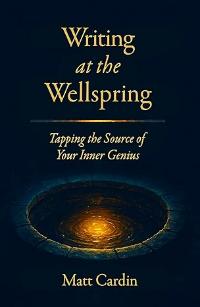
Matt Cardin’s latest book
~ Thanks to Shawn Nevins for letting us know about TAT friend Matt Cardin’s latest book. You can find an introduction to it and links to where you can purchase it at https://buy.bookfunnel.com/qct8mtz42s. See Matt’s article on Seeing through Resistance in the December 2024 TAT Forum.
Please your impressions of the above items.
Reader Commentary
Encouraging interactive readership among TAT members and friends
A reader wrote that what would make the Forum more interesting would be:
Hearing from people who are searching—and have questions instead of those providing endless advice and “answers.” What challenges they are facing. What their doubts and questions are. How they perceive their path is going. What they are doing in their lives. Where they think they will end up, etc., etc.
Can you help make the Forum more interesting?
The Reader Commentary question for the May TAT Forum:
What question or questions would you like to ask people who say they are enlightened / know what they are / are Self-Realized / have no more questions / are Complete, etc.?
Responses follow:
From Bob Harwood:
My question would be, How would you answer the question, ‘Who are you?”
From Richard G:
What would an individual who claim they are Self-Realized or enlightened explain (or discuss) to a skeptic, layman, or curious to further their interest, understanding, or knowledge?
I would add that the explanation attempts to quench their epistemological and ontological thirst or interest.
From Paul Rezendes:
Are there any real final answers? Is there any place to land? Is there anything to hold onto? Can one stay open? Is there any real permanence? Are the past and the future all happening at the same “time?” Are form and emptiness different? Is one more real than the other? Does emptiness come before form or do they co-arise?
From Mike W:
It is a question of self definition – What Are You?
From Mahesh I:
Q1. Has your realization permanently answered all questions and resolved all desires? Do you feel any sense of lack at all?
Q2. Did you expect realization to unfold the way it did? How did it differ from what you imagined?
Q3. Do you now live, function, or observe from a different place or point of view than before realization?
Q4. Looking back, what would you say to your former seeker self?
Q5. Do you feel one must first build a healthy sense of self before seeking genuine realization? What role do emotional maturity, personal development, and relationship to others play in it?
Q6. Is there a relationship between becoming Truth/Love, “growing up” (developmental maturity), and “cleaning up” (shadow work)?
Q7. Do you still experience fears and desires?
Q8. Before realization, did you love Truth/Freedom/God/Absolute more than anything else? If so, how do you love what you do not yet know?
Q9. What would you say your purpose in life was before realization? What is it now?
Q10. Does self-compassion or childlike curiosity play a role in the search, alongside trauma and suffering?
Q11. I sometimes lose my sense of “I” in moments of surprise, beauty, shock, or deep absorption—where experience unfolds but the thought “I” has not yet appeared. Is this similar to your experience some, most, or all of the time?
Q12. How would you describe what happened to you to a child, a teenager, and an adult?
Q13: Is boredom a part of your life? Or is the absence of doing / Silence a ground state of Being, never not there?
From Lena S:
If there was the opportunity of asking a single question, I can’t imagine any other except for “what should I do”?
From Phil C:
What did you discover?
How do you know you’re enlightened?
What was helpful to you on your spiritual path? What was harmful to you?
Sincere spiritual seekers have a deep longing for enlightenment. What do you feel are the 3 most important tips that will help them and/or expedite their search?
What would you say to seekers that might inspire and/or irritate them?
What do you feel is counterproductive or destructive to seekers?
From Dan G:
Are you sure it’s not another trick of the mind? Another compensation to turn from the truth?
How does the mind know of a Self? How does the information get to the mind?
How come we have individual views? How come you Realizing doesn’t also make me Realized?
Is there any truth about experience that’s important to learn? Or does none of it matter vs. knowing the experiencer?
Does this experience make God happy?
Did you learn, is love stronger than death? Why does love allow ignorance?
What should I have asked you?
From Bidhan P:
if I met a person who said they are enlightened, i would try to avoid asking about their current state. As, I won’t be able to relate to it and it has no use for me. So, I would then ask a series of questions (given that I have already provided information about my current state of mind) about my psychological self and thoughts, like my relationship to this being. Can this being live without me permanently? Because I believe suffering is mutual, do I (psychological self) have to self-annihilate or does this being have to see the mutual suffering and release me? Although, I hardly believe any quick answer will give me anything that will alter my perspective on these things.
Moreover, I feel two-way conversation is more suitable than me dumping questions. Discussion I think will help me explore myself in real time. Discussion also invites the person to ask me questions, which can be crucial for me. In my opinion a little nudge is more helpful than giving answers.
From BH:
I’ve heard more than one enlightened person say that their psychological / emotion issues and suffering was resolved before their final enlightenment experience. Richard Rose spoke about an “egoless vector” which I understand to mean a point in a spiritual search where the seeker is no longer seeking for personal concern.
So my question to the enlightened people is: What actually changes after, if anything?
From Anima Pundeer:
Questions I would ask: • Is your innermost angst satisfied? Do you feel settled in your soul? • Do you have unanswered questions that are important to you? • Do desires or fears still drive your life?
From MT:
I am not sure the answering of my questions by an enlightened person would help because there are so many good answers to my questions from TAT Foundation books and other books etc I have read for the last 30 plus years. It’s not so much answers I need…..it is practice. One question I would ask is: Would you spend a night with me looking at the stars from the Nullarbor Plain in the middle of Australia?
From Michael R:
Why do we often hear about tension being a prerequisite of, or at least strongly correlated with, Realization? What role does tension play, how does it work, and why is it sometimes elevated above something like “relaxing into one’s being” as a method for finding Truth?
From Art Ticknor:
What would you say that you’ve found? What’s your level of certainty about it? Why are you that certain?
From Mark W:
I would like to ask self-realized people what they really want from working with seekers. Have they noticed any disadvantages in their life to being self-realized? Did they ever have any doubts about the authenticity of their self-realization?
Other Reader Commentary
From Don A:
When I read Alex S.’s article on gaining feedback in spiritual work in the April Forum, I thought it somewhat a simplistic issue with which to be concerned, until I pondered the effectiveness of the Bosch (LLM-enhanced) painting and how it could directly fore-warn sinners of the horrors ahead of them after death, causing them to repent. I could see that the Church must have considered him an ally as he put the fear of literal physical pain of hell in the not-so-faithful more effectively than any preacher could from a pulpit. It was the various physical contortions and torture of humans depicted that was so visceral. Rather than respond with a guilty conscience, I could literally feel the horrendous physical pain of sinners who were denied any final death, reduced almost to stick-figures but only to depict the never-ending physical torment.
Rather than respond to the painting with such a complex reaction such as guilt or repentance, I found that I remained mostly in the immediate and physical sensory feedback level, as to how my torso, head, feet, hands would feel from torture. But due to my human nature, the physical sensual inputs were highlighted by emotions, too, another physical dimension, a yet more subtle, complex step removed from the physical world. What occurred to me was that even though I am programmed to avoid suffering and strive for gratification, the impact of those two are more cerebral and less immediate than the sensory inputs themselves linked to emotions.
More recently I’ve not known what to make of the scientific finding that the decision-making centers of the mind act after the body as if the cerebral is not the determinant but rather an after effect of the body’s actions. But this would make perfect sense with the recognition that it is the immediacy that is of primary concern to human nature and where attention gets focused. The rational and feeling cerebral functions are as if the next step “going within” into a mental realm, removed from the present and the immediate. But this might seem to contradict the experience of meditation as being a mental practice focused upon the present moment. But it highlights for me that my attention, or ‘seeing’ as the primary ‘activity’ in meditation and not being mental at all, is connected with neither suffering or gratification nor the current moment. The significance being that if one were to pursue a ‘spiritual direction’, it would be away from the physical senses, beyond the emotions and even beyond the mental dimension, and that direction clearly defines that “going within” in the direction that could only be suggested as the more subtle. Although there is so much talk in spiritual circles of being in the present moment, the Now or the “This”, my spiritual aspiration is to turn from the here and now and toward the more subtle, a direction away from the immediacy. In the parlance of Ramana Maharshi, it is investigation of the seen-seeing-seer. D.E. Harding suggests looking into that which looks out. Rose pointed to the viewer of the view, but he also warned of the error of dichotomy in imagining stepping-back ad infinitum and that a retreat from untruth would not be endless, but that only by elimination of untruths might one Become Truth.
But direction implies progress, and progress needs guidance, or that seems to be the necessary human experience, but without authority or feedback from ‘outside’ as to the ‘inside’ progress, upon what could hope be based ‘to get anywhere’? And in phrasing it that way, the problem may be more clearly recognized as unique in that to go inside, outside or progress are adverbs that do not eventually apply to spiritual work. Initially the path may be focused more as a philosophical or psychological endeavor but these can only eventually lead into subtlety where, again as Rose alluded, there are no railroad tracks, guideposts or footprints to follow. But why is that the case? The answer for me, is due to the fact that we live in a relative dimension and as we investigate more and more the subjective or inner experience, we progress further into a paradox of not knowing, of uncertainty as no observation from the outside could be ultimately true or false, that such opposites that could be measured by feedback lose their usefulness or meaning. I understand Alex’s perplexity as to a passion or commitment in life and the urge to keep going but never knowing whether one is ever led -or by what. Favorite phrases of mine are “The Cloud of Unknowing”, and those of St John of the Cross such as “to follow a path that abandons all paths”. These have no meaning except to give hope, no assurance whatsoever except to answer to a more subtle recognition that I only sense that not knowing eventually replaces knowing, and that ‘both and neither’ in all things is some thing we eventually come to live with.
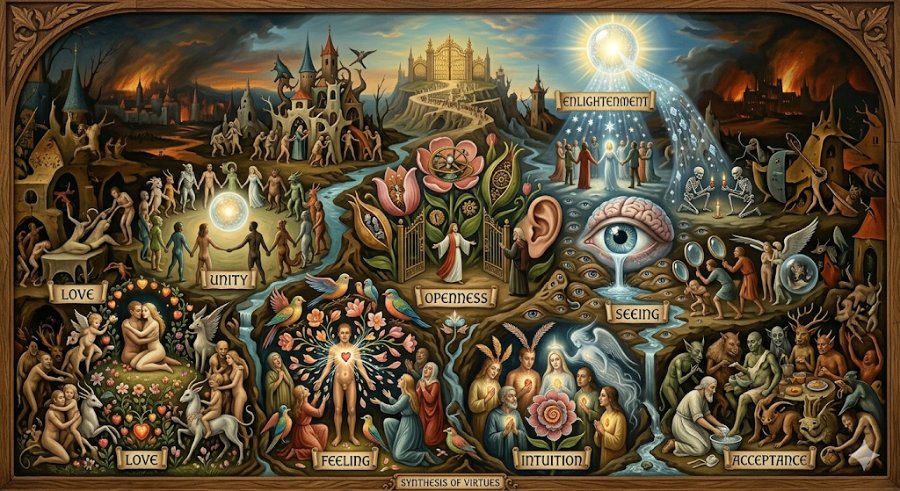
The image generated below was also generated by Google Gemini with similar instructions used by Alex S: “give me a picture in the style of Hieronymus Bosch like the Hell panel of his Garden of Earthly Delights triptych” except that I asked it to depict love, unity, feeling, openness, seeing, intuition, acceptance, enlightenment. Please note that the unearthly ghouls and monstrous humanoids are now agents that do service to New Age beliefs and join human-kind hand-in-hand. Is that Gemini’s subtle suggestion that it too could participate?
=> The Reader Commentary question for next month, the June 2026 TAT Forum:
Invitation to all finders: How would you respond to any or all of the questions that seekers and finders provided in the May 2026 Forum (above)?
Please your response by the 25th of May, and indicate your preferred identification (the default is your first name and the initial letter of your last name). “Anonymous” and pen names are fine, too.
PS: What question(s) would you like to ask other TAT Forum readers?
Q for all: What are your thoughts on this month’s reader commentary? Please your feedback.
Richard Rose described a spiritual path as living one’s life aimed at finding the meaning of that life. Did you find anything relevant to your life or search in this month’s TAT Forum?
Arches National Park, Utah. 2013 photo by Art Ticknor.
We like hearing from you! Please email your comments, suggestions, inquiries, and submissions.
Sign up for notices of TAT’s four annual events, other virtual events, and free monthly Forums on our contact page.
Founder’s Wisdom
Richard Rose (1917-2005) established the TAT Foundation in 1973 to encourage people to work together on what he considered to be the “grand project” of spiritual work.
A Method of Going Inside, part 1 of 4 (or 5) by Richard Rose
I’m going to give you some information tonight on a method of going inside. Previously I’ve tried to give some rather knowledge-laden lectures. I gave one here a couple years ago on the transmission of energy and it went over like a lead balloon – because the terminology was evidently vague, and if you haven’t read along these lines, a lot of this stuff is alien to you.
The whole purpose behind any esoteric or nonconventional spiritual search is the finding of the final answer; you could use such terms as ultimate answer, or absolute truth. In the pursuit of this, if you follow the histories of people who pursued it, we find that it isn’t a systematic intellectual, logical, or even philosophic presentation. We don’t find the truth by proving it in a court of logic. After digging for maybe ten or twenty years you discover that you find the truth, or you’re liable to approach it, by becoming a different vehicle. Not by attacking something and trying to digest it, but by changing your nature, so that you’ll be able to assimilate something of an absolute nature. Because you are finite and relative, and a finite, relative creature may not be able to assimilate an absolute truth.
Regardless, this is where all of the hatha yoga movements end up: in raja yoga.2 All of the manipulatory religions wind up in what they call an esoteric core – the “less finite”. Dan mentioned that I studied to be a priest at one time, and in the seminary they talked about the Thomistic theology3 in which the statement is made that the finite mind will never perceive the infinite – and this is very true. Now this was written at that time to discourage people from looking for the truth, saying you’ve got to believe the hierarchy, because there’s no place to go;
you have a finite mind and you’re not going to get there. But the thing they overlooked was that the finite mind can become different; the finite mind can become less finite.
We’re not going to get into the system of that tonight, but I’m going to try to try to take you through a simple process of going within. And if you can remember this it will be of value to you, because this is the crux of all of this path, after you reach the decision that you have to change your nature, that you have to become. It’s based, first of all, upon five properties of the human mind. Now I completely avoid and bypass what is known as current psychology, the psychology that has developed down through the years to where it is today, and certain definitions they have of the mind.
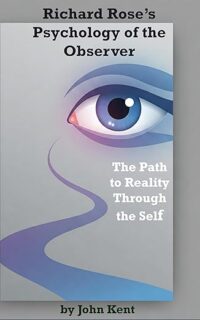
At one time I believed that there were only three qualities of the human mind: perception, retention and reaction.4 If you look at it for a minute you’ll see why I said that; basically, you can get all of the things that happen to a human being down into those three categories: you perceive, you retain as memory, and you react. But these are not necessarily properties – they are things that happen to us, without us controlling them. When you look at it a little deeper you see that there’s something else that can be added; they’re still limited to these three categories, but there’s a variation in two of them. So that we have two types of perception: sensory perception and mental perception. It’s still perception but one of them has to come through the senses while the other can come directly. The mind itself can see. And after you meditate or think on these long enough, you’ll encounter this thing called visualization. Now visualization is one method of mental perception, and there are others. The mind can be trained to see directly, such as in ESP, astral projection, these things. The mind can see by itself. It’s still perception, and it still records on the mundane memory.
And there’s another quality we add to these three and that is projection;5 as things come into the human organism, things also can be sent out. Now projection would seem to be the only thing that the human being does. He can’t stop perceiving; he can’t prohibit or stop remembering – the action called memory is going to happen whether he wants it to or not. And he can’t stop reacting, although perhaps he can desire to react a certain way, which is called morality, a moral reaction. And of course there’s some question as to whether you can even control the moral type of reaction. But this projection would seem to be something that we can control; that it’s the first time that we do something. We’ll see if it’s possible to actually control that – I don’t know whether it is. But as far as everyone generally thinks, we can.
Viewer and the view
Now this whole theme hinges on a very simple point: that the view is not the viewer. In a search for the self we are looking for the viewer; we are looking for him who sees. We’re looking for the self, in other words. There is a self. But strangely enough, the smartest people, meaning intellectually smart – men of degree and reputation, doctors even, psychologists – very seldom
_____
4Psychology of the Observer, pg. 20-21 and 26. 5 The second form of reaction.
really define “I” or “me” or “self“ properly. This is a massive assumption that is crossed over, to the extent that when you start defining this thing you’re going to get into endless discussion and proof. But it’s just a very simple and logical deduction that if you’re looking for yourself, it’s not the environment. Now – where does environment end and “me” begin? Where is the “me” that is the essence-me?
Let’s take a simple situation: a person lying in bed smoking cigarettes. Let’s just first present it in a picture: Your toes are visible, and possibly by smoking you’re even aware of your lungs. But we realize that the toes are not us, basically because you can amputate them and keep on living. And by the same token, if you smoke too many cigarettes they might even take out a lung. You might take out a good bit of your body and still live.
So you’re going to have to identify the rest of the body likewise as not being us, not being the central “we”. And when you do this you start to embark upon what I call a retreat – a retreat from the common definition that is assumed by most people: that “us” is the body; that “us” is that which we would like to think we are; or that “us” may be body and mind or body-mind. Modern psychology seems to hint that there’s no such thing as a mind outside of a body-mind, a reaction mechanism. Incidentally, this little five-part formula for the human mind’s attributes doesn’t argue with modern psychology in this respect – except possibly for the idea of projection – that the body can be blamed for a tremendous lot of this: The body is the one that perceives through the senses, the body is the brain, the brain is somatic, the DNA molecule is somatic.
And the reaction is automatic – it’s like an electrical current triggering something and causing a reaction. But I think after you dig awhile you become aware that the somatic mind is identifiable and it is not us.
So when you start looking, you start by looking at your actions – and you generally don’t see your actions until you get a reflection from someone else, or you run afoul of society and run into criticism, or you get sick. So let’s say in the process of smoking a cigarette the person develops a cough, and he gets the fear that maybe he’ll be going into cancer. And this is when he realizes that the one who decided to smoke the cigarette is not him, because he argues with him – and by this he finds himself looking inside. We’re going into a meditative process now – this is what we’re trying to do tonight – take a person into a phase of simple meditation: what you would think about if you were lying in bed smoking a cigarette. This might be what would enter your mind. And this will lead you back to just simply analyzing your actions, to see which of those actions are you and which aren’t you.
And we find that we’re a composition – our so-called personality. We may have abandoned the idea that we’re the body by looking at our toes and our fingernails, and saying that this evidently isn’t us – because in seven years the entire body will be changed, it will be a different us. So where is the unchanging us? Where is this thing that is really us forever? Or which is the most durable part, if it is not that? But we come to some conclusions: that we eat and we want to eat, we want pleasure, we want power, peace of mind and a few other possible objectives – and that some of these things conflict. They conflict so strongly that we decide at some given time that they are not us.
Now take the case of a fellow who drinks. He once decided that it’s a harmless pastime, it’s just a few beers – and the next thing you know he’s an alcoholic. And eventually he gets put in jail or he gets into a fix – he may lose his property or something like that. But he gets into trauma, and he realizes that this is not him. And then he goes – he doesn’t say, “We’re going down to the doctor,” no. “I’m going down to get rid of this monkey that’s on my back.” He finally realizes that it’s a monkey on his back. Before that he thought it was one of his voices or egos – he was expanding, he was using alcohol to stimulate his business and become rich and powerful and popular and everything else, that it’s a great social lubricant.
So we find that the personality, the thinking process that we took to be our mind, that we thought was us – we find that the mind itself is playing tricks. Over a long period of time – sometimes ten and twenty years build up before a person realizes that something inside of him has played tricks on him. So we’ve got a dichotomy. There’s a manifest dichotomy, no way around it: how can a person play tricks on themselves? But this is manifestly true. A fellow is put in jail and somebody says to him, “You’re a drunk,” or, “You’ve got a habit.” Or he’s in jail because of some social habit, or he rapes somebody or he steals. All of these are the result of appetites. And these appetites are the result of what I call voice-drives. And these accumulate – they don’t necessarily start spontaneously in a few seconds.
So the person goes along in a certain way and suddenly has to face himself. And it doesn’t have to be a really violent or traumatic thing that brings about this revelation; there are lots of little things – just the fact that you don’t get along with people. You build up a certain phase in your personality that you believe is you, and you go along and you prosper with it. And then one day it falls apart. Your personality gets you fired from your job, or your girlfriend or boyfriend drops you and says, “I can’t stand you anymore; you’re too hard to get along with.” And then we see that there’s some part of us that we don’t like. And all of us will admit this dichotomy, that there’s no such thing as a monistic mentality, a monistic mind. We admit the dichotomy now.
Umpire
I maintain that this is our first view of the mind. And a tremendous lot of people assume that this is the only mind there is. But I call this mind the umpire. It’s part of the program, the computer. This is a physical mechanism, and the physical mechanism is set here for a certain purpose. It’s programmed to produce its own continuation; it’s programmed to survive. So that these different impulses, which conflict with each other to a certain extent, are still parts of the person that are thrown into the computer when the person is born. They’re implanted.
So then, why is a person born? Manifestly, if you take the end result of what happens in what people do with their lives – we’re manifestly born to reproduce. So we have a sexual urge backed up by a survival urge – everything has a survival urge – and here are two urges working together, reinforcing each other. And then add the pleasure urge. All of these things seem to harmonize together to make a powerful drive toward reproduction.
Now, say the person has the desire for reproduction but maybe economically is not too keen – has trouble getting a job or something of that sort, or maybe has too much of a reproductive urge – lord knows what causes it – but we hear of a lot of people getting into trouble because of their reproductive urges. And the fellow gets rebuffed – whether he gets rebuffed by his mate or his would-be mate, or whether he gets thrown in jail for rape or whatever the score is. But it’s possible that one of these urges that we identify ourself with very strongly can be so obnoxious that we finally will not identify it any longer as being us. It is something that afflicts us. So then an interior sense, an interior voice says, “Hey, that is not you and you’d better do something about it, if you want to live.”
And that’s what happens. Something is watching the man raping and going to jail, or getting rejected or losing his job – and this is the viewer. This is the viewer, the rapist is the view. The umpire becomes the view. We are watching. That which watches is the essence, and that which is rejected by that anterior6 mind is not us. If it were us, well then we’d be suicidal; we would be allowing one of these voices to destroy us. (Well, we generally do anyhow. We generally wind up destroyed by the various voices. Ambition or sex or booze or something gets us, because we can’t hold a balance with all the different appetites that assail us.) So there is in the computer, built in, an umpire, which is not us. We can watch it working, and if you can watch something that’s working, whatever is working is the view.
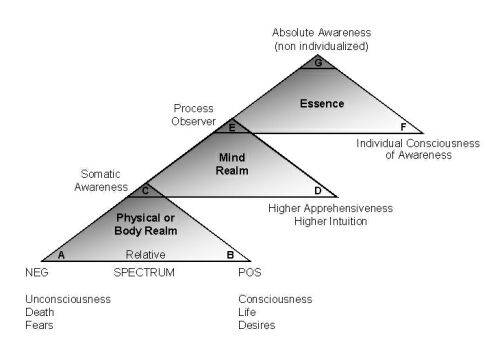
Process observer
So what is watching the umpire? I call it the “process observer”. These are simple terms; rather than use complex psychological terms, or try to keep abreast of psychological terms that would be similar, I prefer to pick something very simple. Now we’re going through a meditative process in what I consider an orderly, common-sense way.
There’s another analogy that I’ve used at times called the camera analogy, in which I liken man to be a ray of light that comes out of a camera towards a screen. And the screen is the void.
These are more or less Zen-ish terms, in which the world is looked upon as an illusion – which is a hypothesis because that’s not known until you prove it’s an illusion. But regardless, there is a way. In our meditation, if we feel that we are nothing but a ray of God or something of that sort, there’s only one way to approach that. And that’s not to theorize in dictionary-terminology such as theology might employ, but to actually get into that ray and go back through the camera. In other words, go to the source, instead of verbalizing.
But what we’re doing here is a much simpler way, because you’re watching your own actions. You watch your observation of the umpire, of this decision-making process, and you find out that you’re aware; you become aware that you are watching it. You’re watching processes, you’re watching the manipulations of the mind which are not us. And this is why in Zen occasionally you’ll hear this term “kill the mind”. This is the mind they talk about killing. A lot of
_____
6 Rose uses the word “anterior” (literally, front) to describe an inner or more real perspective, but in conjunction with words like “getting behind the mind” this seems contradictory; however, “anterior” also has the meaning of “preceding”. Also see footnote #17.
people think that when they say “kill the mind” it means to overdose on drugs – that this is the path to enlightenment, to kill your head or something. No – this is the trouble with picking a word out of a text, from an old philosophy that has been translated for four or five hundred years, and trying to explain it or trying to use it fundamentalistically for your own use. When they say “kill the mind” they mean to kill the mundane mind – not to kill it necessarily, but this is a sharp word to emphasize that something drastic has to be done. But you have to get beyond the umpire.
You have to get beyond this need to continually ride herd over these appetites and the counterchecks to the appetites and all this sort of thing.
Before we got to the process observer it was very simple observation: We see a bottle of whiskey, we see a thirst, we have a sensory understanding that these two things can cause trouble or pleasure, or both. But when you get into the process observer your mental observations become gestaltic.7 Now when I use the word gestalt I’m talking about pattern thinking, not in the Fritz Perls idea of gestalts.8 The original idea of gestalts was that we think in patterns. Sometimes a single word may symbolize an entire philosophic approach. A few seconds of thinking along a certain line may embody a whole philosophy – this is what I mean by gestaltic thinking. The process observer is a gestaltic operator. And it starts watching. This is the real meditation that sets in, the real raja yoga or whatever you want to call it, whereby a person watches his mind go through certain loops and shenanigans, gymnastics and so on.
And then somewhere along the line he becomes aware of the process observer itself. Because we’re watching this thing now: something is watching the observer watching the umpire. Now what are we getting to? We’re getting to where we might think that there’s no point from which you can’t watch something else. So it looks like the real self is going to escape you; it’s just going to go further and further back – every time you look it’s going to be behind you, or behind that operation. But this isn’t true; it’s simply a matter of purification – a purification of the concept of self.
So that when you come down to the final self it will not be by logically finding a kernel inside of a kernel inside of a kernel. It will be a cracking of the final kernel. And when this occurs, then all of these things are – not illusory; in their own dimension they are real and necessary – but they are not the real self. They are all relative and describable. The final realization of course isn’t necessarily describable, because of the nature of what happens, and by what has been demonstrated or talked about by people who made the breakthrough.
To give you some hints on the type of mental processes you have to take into account in order to get behind this process observer (and you really have to get behind it): What happens in the observer who watches the process observer, is that this person just watches. This is awareness. This self watches, and that’s all. And when you get to the point where there’s only watching, and no qualification, you’re getting pretty close. Now how does this happen? We’re getting close to an absolute watcher. We’re not getting something that defines things as good or bad, white or black, high or low, in or out. And the reason this type of observation is necessary is because of the field that we’re studying.
Did you enjoy the Forum? Then buy the book! Readers’ favorite selections from seven years of issues. Beyond Mind, Beyond Death is available at Amazon.com.
Our free monthly newsletter with essays, poems, and reader commentary· Sign up today and get an excerpt from one of our newest publications: Hope! Life's Calling.









 Update for the Online Self-Inquiry Book Club:
 Esoteric searchers, transcendentalists, mystics, scientists for the new frontiers…